- HOME
- Pricing mechanisms and Strategies
- How to automate usage-based billing: A starter guide
How to automate usage-based billing: A starter guide
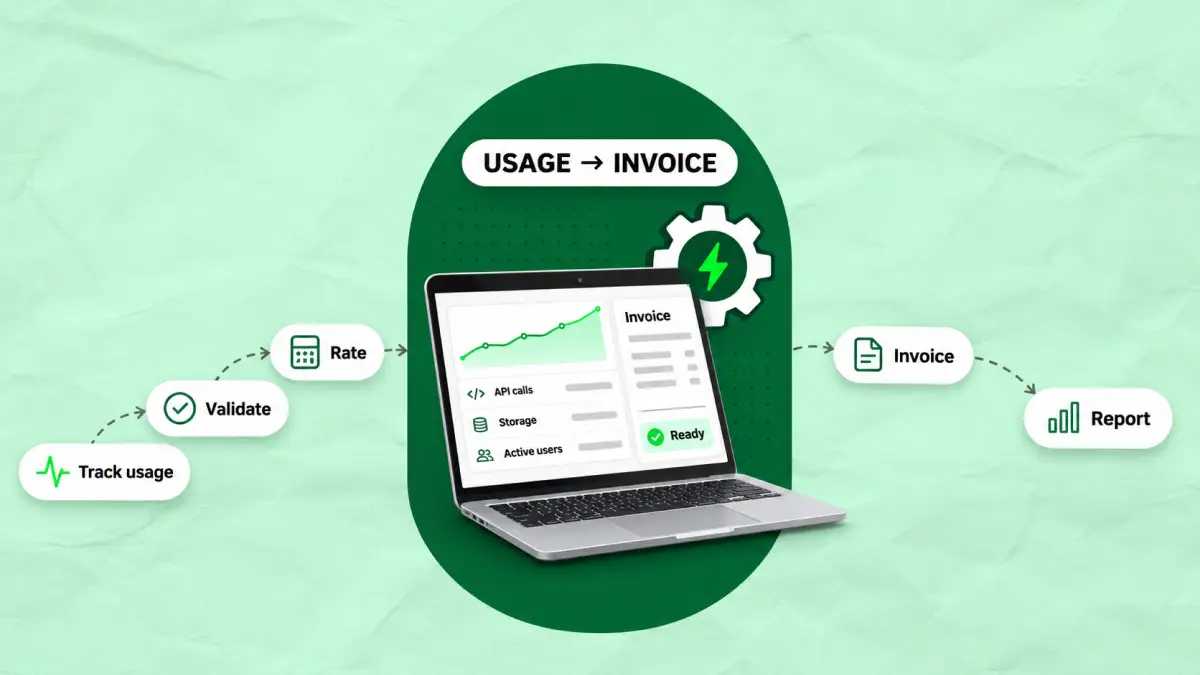
The share of software vendors offering pay-as-you-go consumption pricing is expected to rise from 42% to 61% within the next two years, according to Simon-Kucher’s Global Software Study 2026, which surveyed 492 software executives. That is a lot of businesses rewriting their pricing pages, and as the same firm noted in a piece on running usage-based models, while a pricing page can be rebuilt in a week, “the organization behind it takes quarters.”
So for most teams, choosing the price is the easy part, and the execution — billing — that has to follow is where things start to creak. Someone is required to export usage logs into a spreadsheet at month's end, someone else is checking the numbers against the contract, and the invoice goes out a week late, that too with a figure the customer wants to talk about.
This guide walks you through how to implement usage-based billing (UBB) in a way that holds up, and how to automate each stage so the process keeps running without having someone babysit it every cycle.
Why does usage-based billing feel harder to implement than to price?
With a flat subscription, you know the invoice before the month even begins. With usage-based billing, the revenue number becomes a question that only gets answered at the end of the cycle. The answer depends on the customer's will and need to use your service. Operationally, that data:
→ Lives in your product
→ Gets counted by your systems
→ Gets mapped against the pricing rules you set
→ Reflects in your invoice accurately
→ Turns into revenue
Every handoff in this chain is an opportunity for a number to go missing or get counted twice. Building a unified system here is what will help ensure these mistakes never happen, especially at scale.
Strategy: What needs to be decided before you automate usage-based billing?
Automation only repeats whatever logic you give it, just faster. If the logic is fuzzy and broken, you will end up accelerating the mistakes at a faster pace, creating multiple fires for you to put out. Because, at scale, it produces confusing invoices and mistaken numbers. These might look very much avoidable, but they happen when organizations move head first into experimenting with new systems. So the first step is from the pages of the old book: Gain clarity before control.
Step 1: Choose a value metric your customer already understands
The value metric is the unit you charge for, and the best ones mirror how the customer already thinks about the benefit they get from you. Twilio charges per message sent, and Snowflake bills on the compute credits a customer consumes. In both cases, the customer can look at their own activity and roughly predict the bill.
Step 2: Decide how the price behaves as usage moves
Once you know what you are counting, you need to decide what happens to the price as that count climbs. The common structures are:
Per-unit pricing, where each unit carries the same rate
Tiered pricing, where units in each slab are charged at that slab's rate
Volume pricing, where the total quantity decides one rate for every unit
Base fee plus overage, where a plan includes a set allowance and anything above it is billed separately
Prepaid credits, where the customer buys a block upfront and draws it down
Many businesses end up with a hybrid and it's reasonable — a base subscription that covers predictable value with a usage component on top. Usage billing, while being highly beneficial for customers, can affect the predictability of a business's revenue, due to its variable nature. Plus, it does a lot for forecasting, since part of the revenue stays steady while the other part grows with the customer.
Step 3: Define what counts as a billable event
Define what a single billable event looks like: which customer it belongs to, which timestamp decides the billing period it falls into, and how you spot duplicates and delayed records. A retried API call that gets counted twice might seem small when evaluated individually, but repeat it across a few thousand customers and you'll have rising support tickets on the other side.
The real implementation: How does usage travel from your product to the invoice?
Step 4: Capture and send usage automatically
Your product should send usage records to the billing system through an API, either as each event happens or in scheduled batches, rather than relying on someone to upload a file. Batching works fine for most businesses, as long as the batches carry identifiers that let the billing system reject duplicates.
Step 5: Let the billing system rate and invoice at cycle close
At the end of each billing cycle, the billing system should apply the pricing rules from Step 2 to the aggregated usage and generate the invoice on its own.
Zoho Billing supports per-unit, tiered, volume, package, overage, and credit-based pricing; it can record usage through REST APIs or manually. It also prices the usage units against the rules you have set automatically and generates itemized invoices to reduce usage disputes. On top of that, it also helps you collect the charges and manage revenue, which brings us to the next step.
Step 6: Automate collection and the awkward conversations
Usage invoices change every month, and that makes customers read them more closely. Two things help here. First, keep your customers updated on their usage. Second, set up automatic payment retries and reminders for failed charges, so the finance team only steps in when a case needs human intervention.
Zoho Billing keeps the customers updated via customer portals and has extensive dunning options to recover payments.
How do you know the automation is working?
Step 7: Run a parallel cycle before you switch over
Before you retire the old process, go back through the steps above, though not all of them in the same way. The first three are strategic decisions. A weak value metric or a vague event definition will eventually show up in the numbers, but on their own they don’t tell you whether the implementation itself is working. The real test is in the stages that follow, from capturing usage through to collecting payments, and those need close attention during the first few billing cycles.
Trace every issue you find to the step it came from. A problem with a clear address is far easier to fix. Here are a few example cases:
Run one cycle in both systems and compare the invoices line by line. If the quantities don’t match, look first at how usage is captured and defined (Steps 3 and 4). If the quantities match but the amounts don’t, the pricing rules behind the rating need another look (Steps 2 and 5). Catching either in the first cycle lets you nip it in the very beginning.
Once you’re live, keep an eye on two numbers. The first is the gap between usage recorded and usage invoiced. If it widens, events are being lost or counted twice somewhere between capture and invoicing. The second is how many invoices still need a manual edit before they go out. Each edit is a rule the system hasn’t been configured with yet (Steps 5 and 6).
When those checks settle, step back and look at the whole process. How many people touch a usage invoice before it reaches the customer, and how many of those touches exist only because two systems don’t talk to each other? As that number comes down, month-end close gets much lighter for the finance team.
Need help with implementing UBB for your organization?
Usage-based billing demands more of your systems than a flat subscription does. Once the value metric, pricing rules, and event definitions are settled, the rest of the flow can run largely on its own, and your team only steps in for the exceptions. Zoho Billing Enterprise Edition handles everything from processing and rating the incoming usage events to collections. It also provides insight into the revenue generated by your usage-based offerings with AI support to speed up your analysis.
If your usage-based pricing (UBP) model and billing processes have a few twists of their own, you can book a conversation with our team to walk through how it would work for your business.
Frequently Asked Questions
Concertizing your pricing strategy and finding the right system for it is the first and biggest step. Then it's all about codifying your processes. Send usage records to the billing system via API with unique identifiers. Then, let the billing system apply your pricing rules, generate invoices at cycle-close, and handle payment retries on its own.
Yes, and a hybrid plan is usually the gentlest route: Customers keep a familiar base fee while a usage component is added on top. Even if the new plan looks beneficial on paper, customers might be aversive to change initially. So clarity and structural onboarding is essential.
Decide this in advance as part of your billable event rules, define what is late usage and communicate clearly when is the cut off time for usage tracking and make sure your system is configured with the essential rules.
Usage revenue is generally recognized as the customer consumes the service. Prepaid credits, for example, sit as deferred revenue until they are used. Hybrid contracts mix fixed fees, credits, and overages, and each part may follow a different schedule. This guide on usage-based revenue recognition walks you through it.