10 AI agents for sales you can build in your existing CRM
- Last Updated : November 9, 2026
- 192 Views
- 12 Min Read


For your sales processes to evolve in line with the ever-changing business landscape, it's essential for your CRM to adapt to these changes. The Agentic era provides you with a reliable and faster solution to achieve this: AI agents, which constitute a digital workforce that can think, analyze, decide, and act like a human workforce can.
These agents have gradually entered into CRM operations to provide a wide range of possibilities to enhance your sales processes. The real power, however, rests with how you use your agents. But when you're new to agents, it's normal to wonder, "How do I get started with AI agents? What AI agents do I build?"
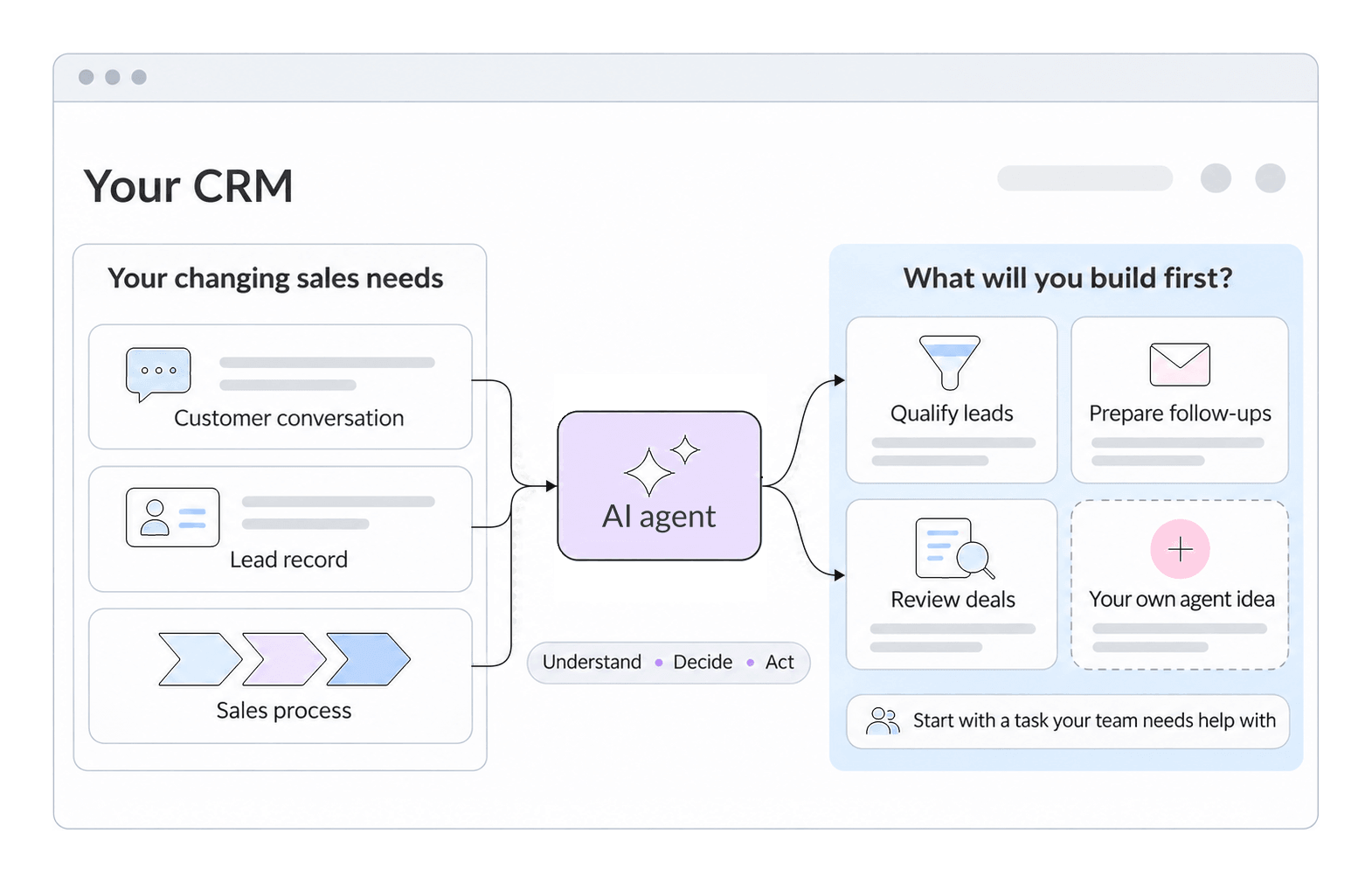
If this sounds like you, you're in the right place. These AI agents for sales examples will help you choose a practical starting point and build AI agents around your team's needs.
What are AI agents for sales?
Your sales reps face everyday challenges such as fragmented lead information, incomplete CRM records, conversations spread across channels, and repetitive administrative tasks. AI agents for sales can help your reps handle these daily challenges more efficiently.
These agents use customer information and business instructions to interpret tasks, choose appropriate tools, and take or recommend actions. In your CRM, they can help qualify leads, prepare follow-ups, review deals, and support other sales tasks within the permissions you set.
A fixed workflow follows the rules you configure, but when you use AI agents for sales processes, they can interpret a conversation or request in context and choose among permitted steps. For example, your agent can read discovery notes, assess whether a prospect meets your criteria, and prepare a relevant follow-up draft for your rep to review.
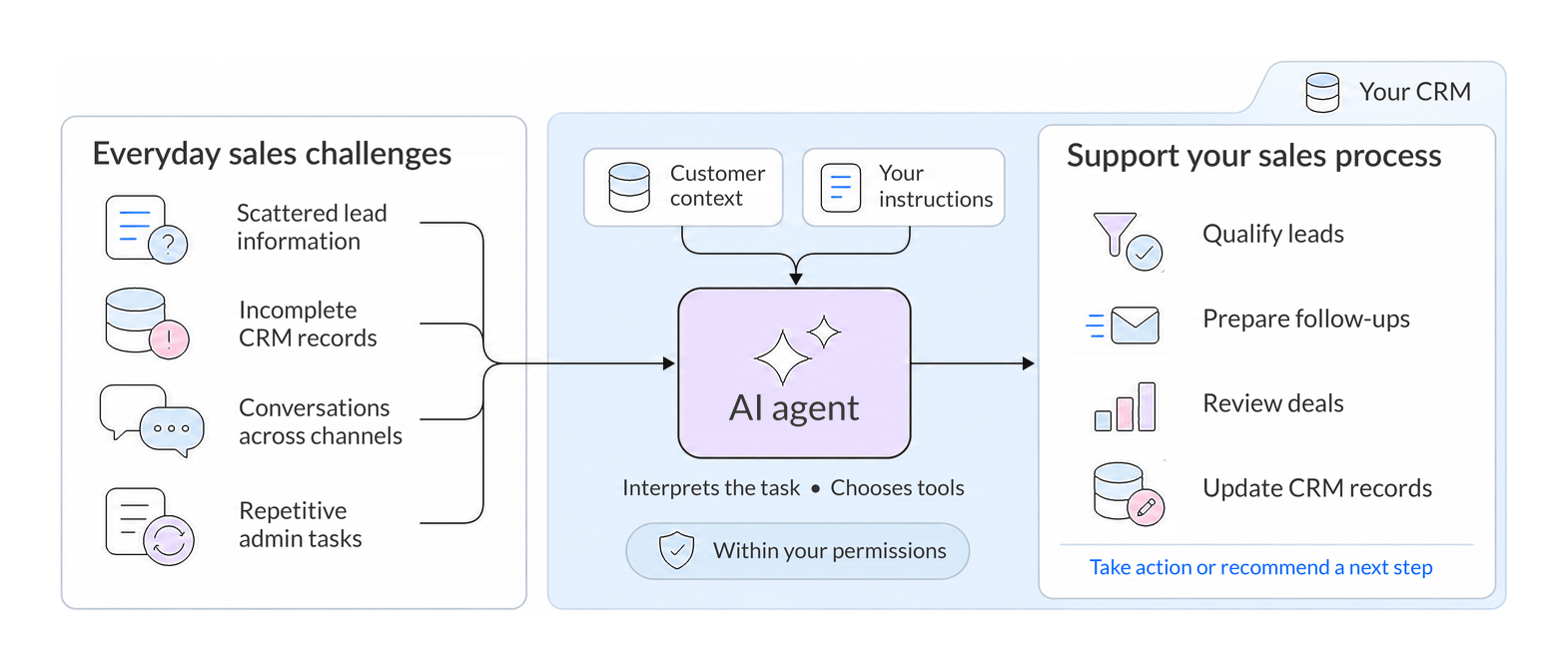
Listed below are 10 AI agents for sales you can build to support your sales processes and get the most out of your CRM:
Lead qualification and follow-up draft agent
Product guidance agent
Duplicate lead detection agent
Sales priority agent
Competitive advantage insights agent
Sales hand-off agent
Sales delivery feasibility agent
Cross-sell and upsell agent
Admission inquiry and enrollment agent
Tender review and proposal agent
1. Lead qualification and follow-up draft agent
The challenge
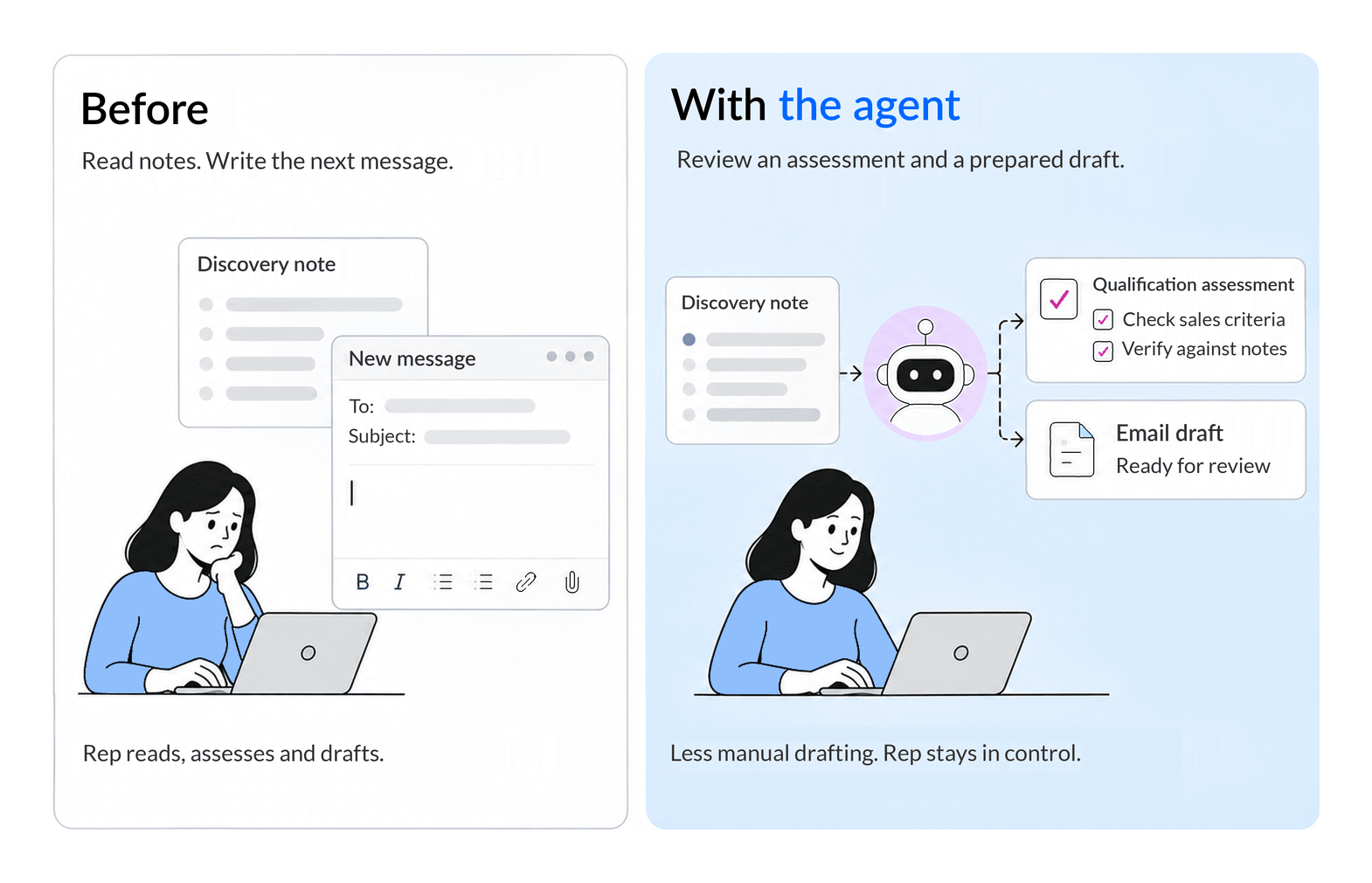
After discovery calls, your reps still need to decide which prospects are ready to move forward and write the next email. Reviewing multiple conversation notes and drafting personalized emails can delay follow-up and pose the risk of losing out on the lead.
The agent
You can build an agent that reads your qualification notes, assesses them against your criteria, and updates prospects' status in your CRM. For qualified prospects, it prepares a personalized email draft for your rep to review and send. It records a reason why certain prospects are disqualified and marks incomplete or uncertain notes for further review.
The process
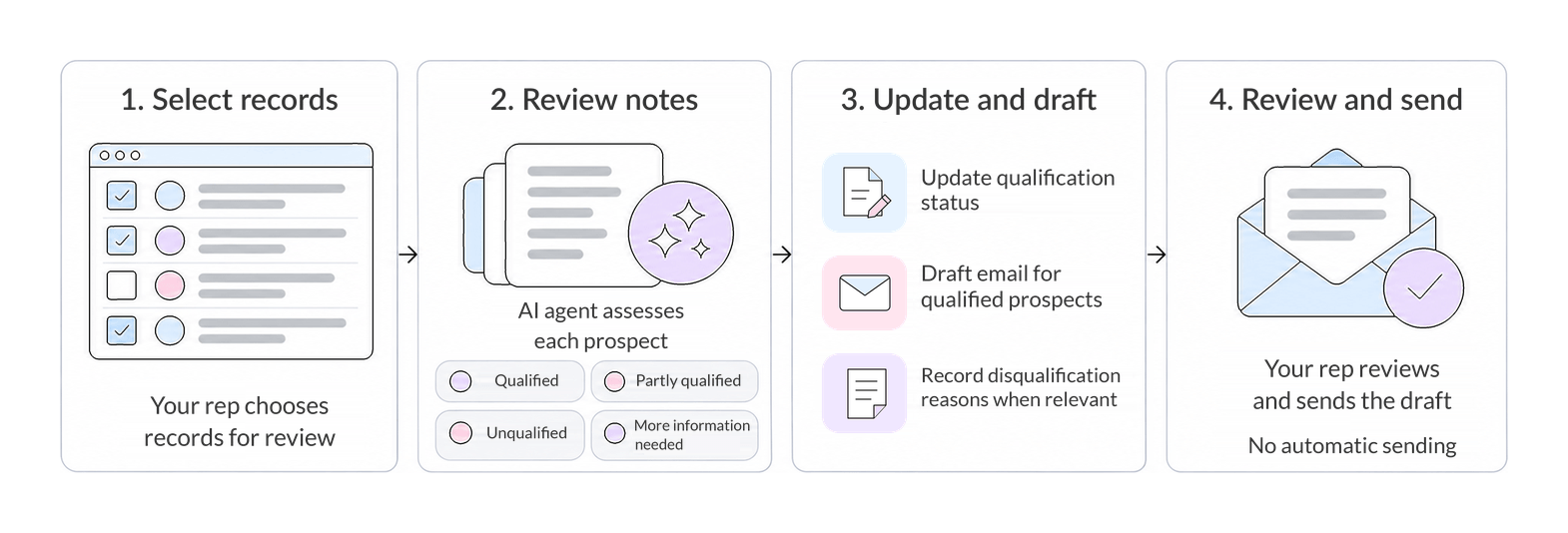
The outcome
Your reps spend less time reviewing notes and drafting emails, so they can focus on qualified prospects and follow up sooner. Each prospect's qualification status and any disqualification reasons are recorded in your CRM, while your reps review and send the email drafts.
2. Product guidance agent
The challenge
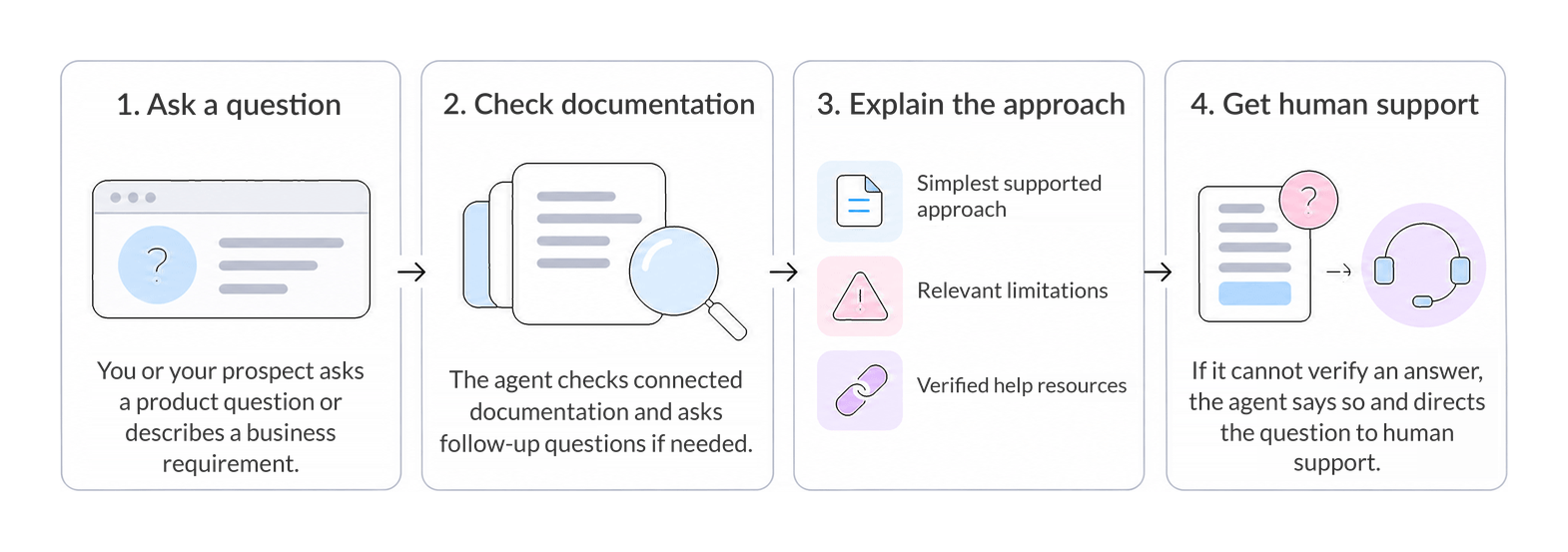
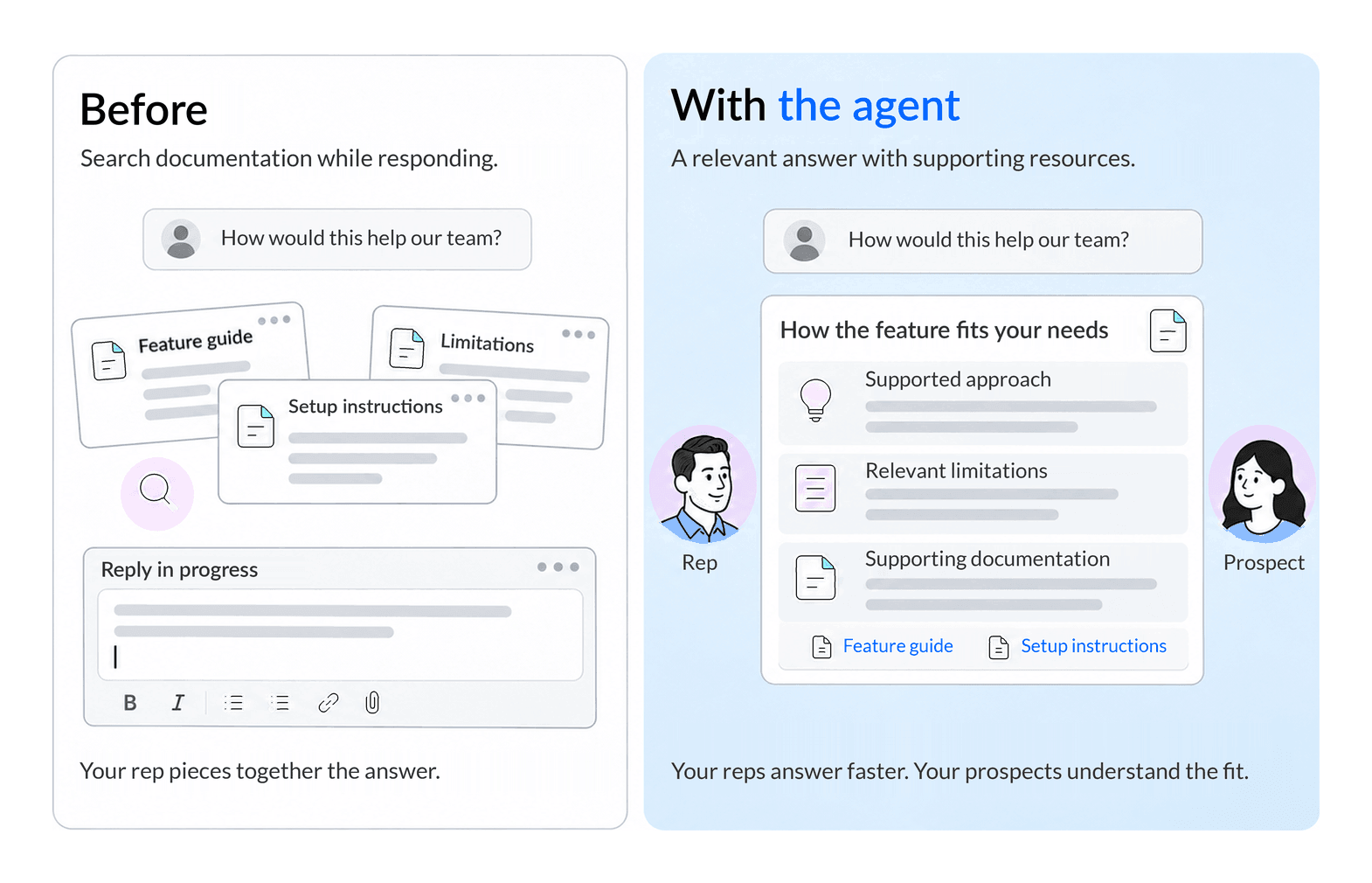
A prospect asks whether your product can support a specific requirement. Your rep needs to understand the requirement, check the available features, and explain a suitable approach without making promises the product cannot support.
The agent
You can build an agent that uses approved product documentation to answer customer queries and recommend a suitable solution. For example, the agent can help prospects and new users understand which of your CRM's capabilities can address their needs, which editions are available, and setup options. In cases where the agent is unable to provide a satisfactory solution, it can connect your prospects to the relevant human support.
The process
The outcome
Your reps can answer product questions faster, and your prospects can clearly understand whether your product meets their needs. By also explaining relevant features and limitations, the agent helps both parties move forward with clearer expectations.
3. Duplicate lead detection agent
The challenge
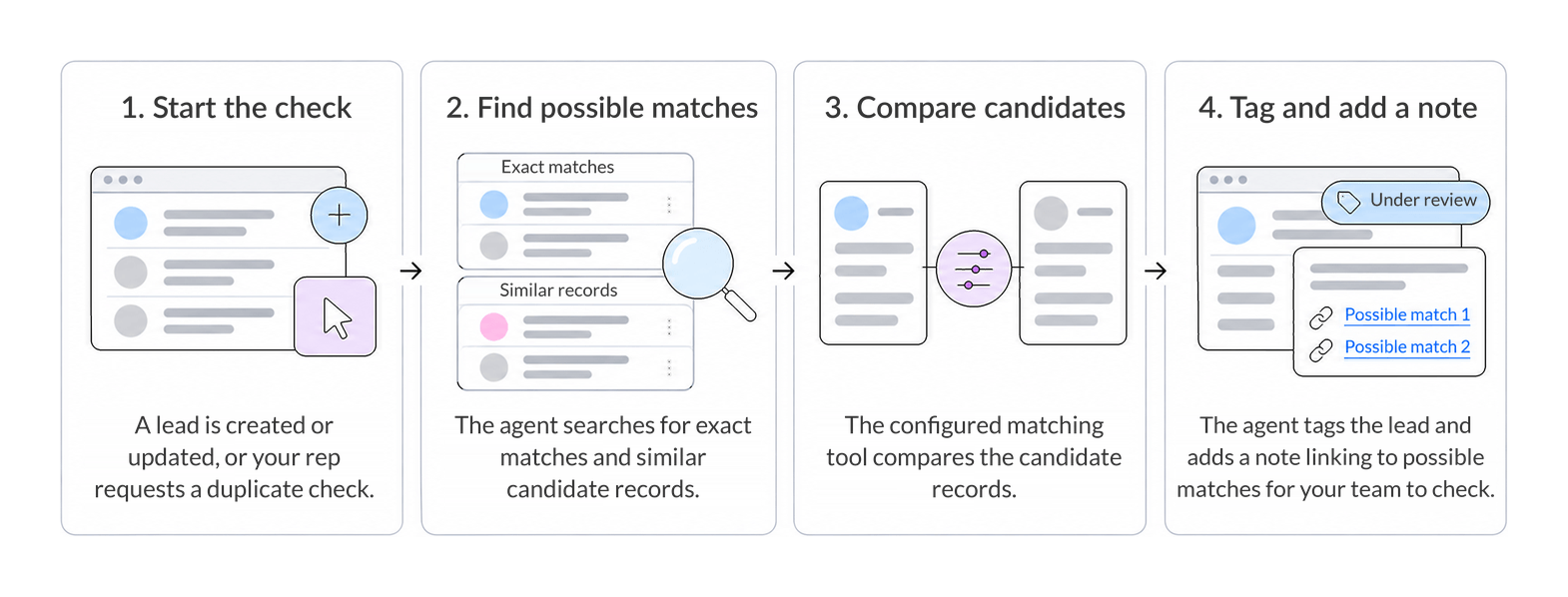
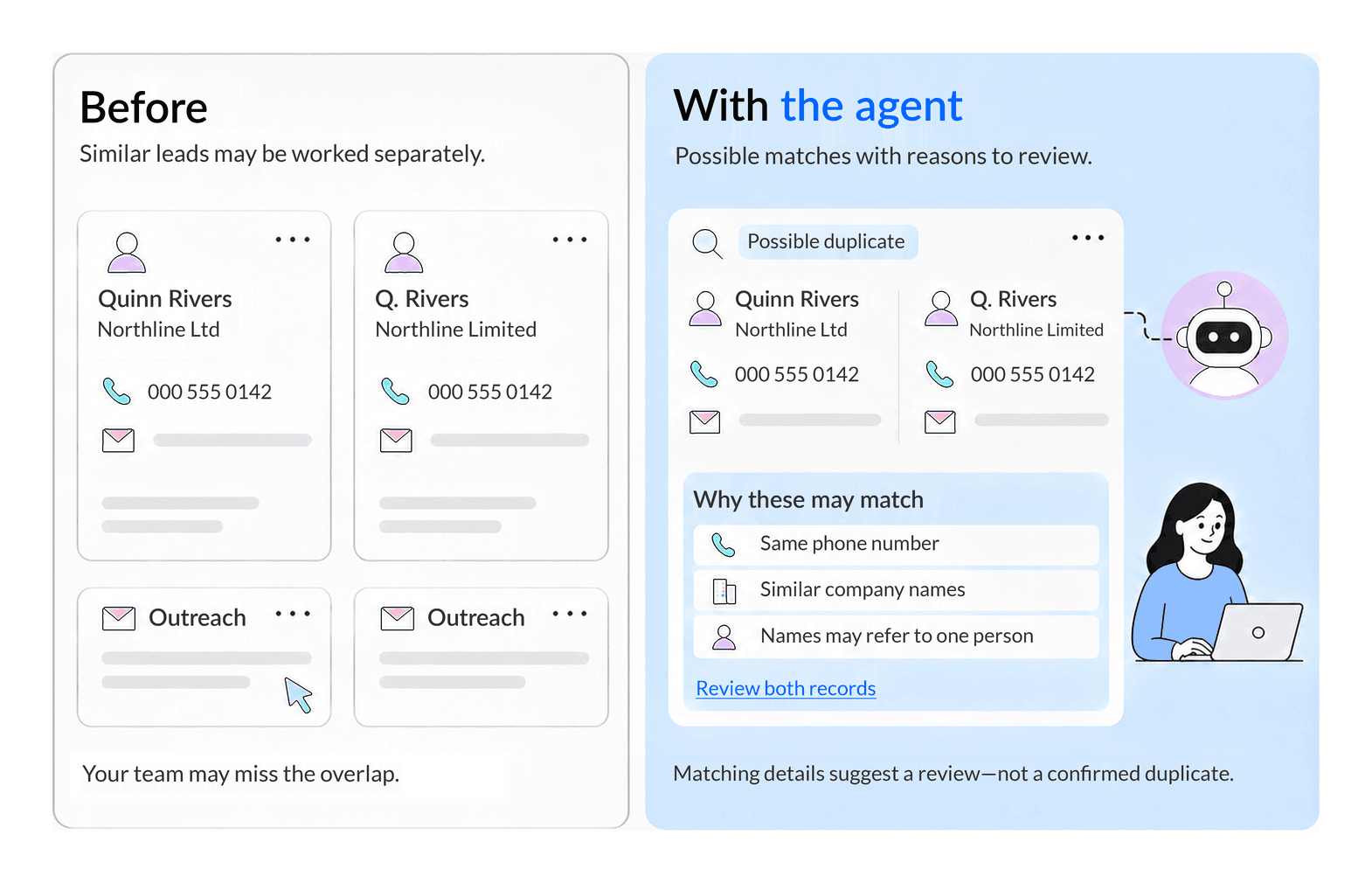
The same prospect can enter your CRM through a webform, a trade show, or a manual entry. Minor differences in names or contact details can leave multiple reps working from separate records, but all of them reaching out to the same prospect—thereby leading to a clumsy lead nurturing process.
The agent
You can build an agent that searches for possible duplicate leads and compares details such as phone numbers, email addresses, companies, and names. The agent uses a matching tool to check how closely the lead details match, then flags potential duplicates with a note explaining which details are similar. Your team decides what to do with the records; the agent does not merge or delete them.
The process
The outcome
Your reps can spot overlapping lead records before continuing outreach. The explanation helps them distinguish likely duplicates from different people who happen to share a company or similar name.
4. Sales priority agent
The challenge
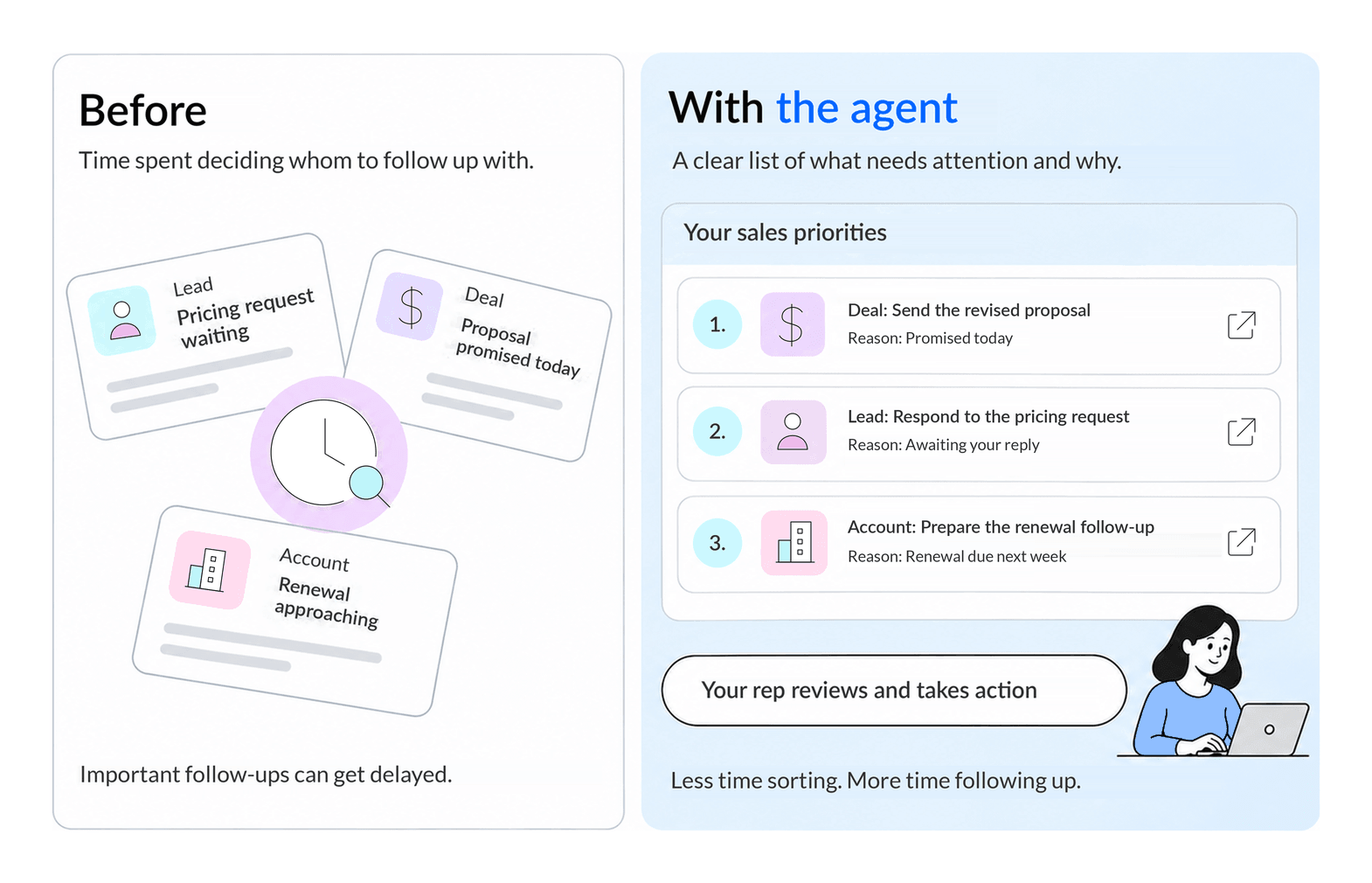
Your reps juggle new leads, ongoing deals, and customer follow-ups every day. A lead may be waiting for pricing, a prospect may need a revised proposal, and perhaps a customer's renewal is approaching. With updates spread across CRM records and conversations, your reps can spend valuable time deciding where to focus while important follow-ups get delayed.
The agent
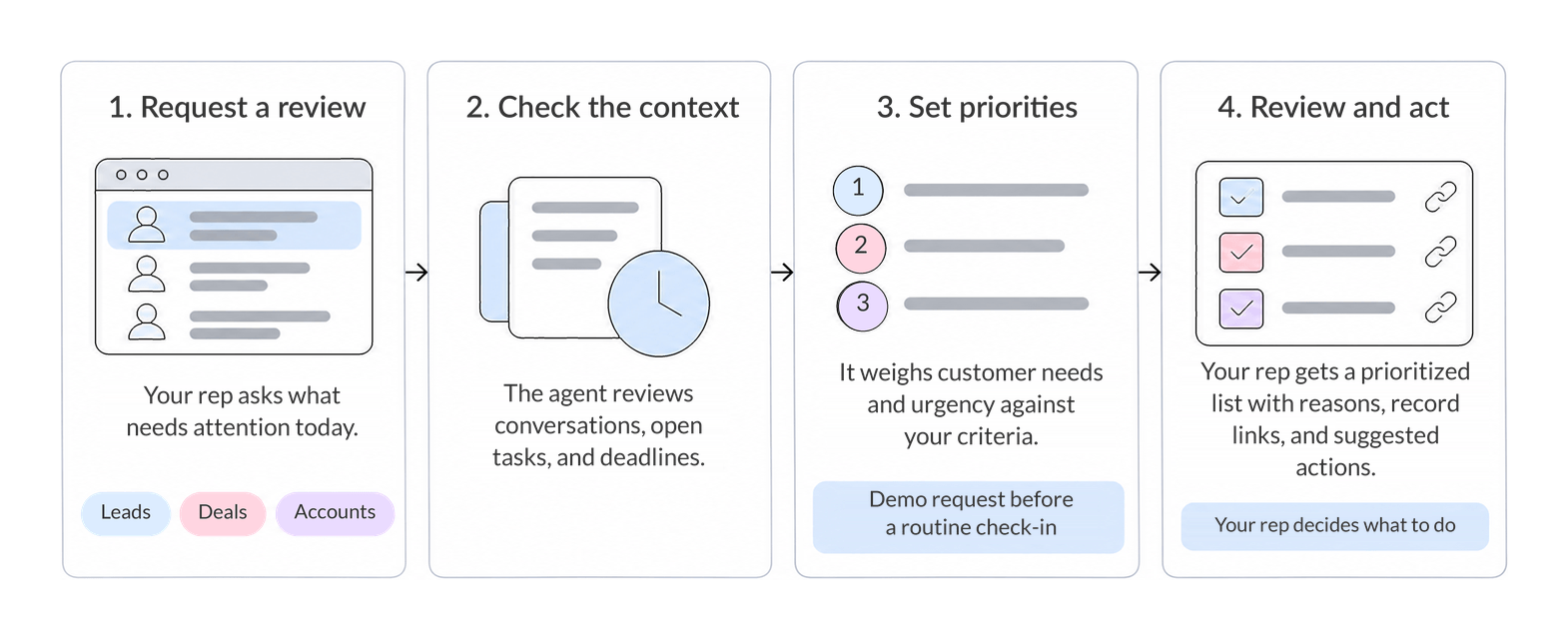
You can build an agent that reviews your reps' leads, deals, and customer accounts to identify what needs attention first. It considers recent conversations, pending tasks, and upcoming deadlines alongside your business priorities. Each recommendation explains why the item matters and suggests a next step.
The process
The outcome
Your reps get a clear view of who to contact and why, without manually reviewing every record. They can respond sooner to interested leads, keep customer commitments, and follow up on deals before progress stalls.
5. Competitive advantage insights agent
The challenge
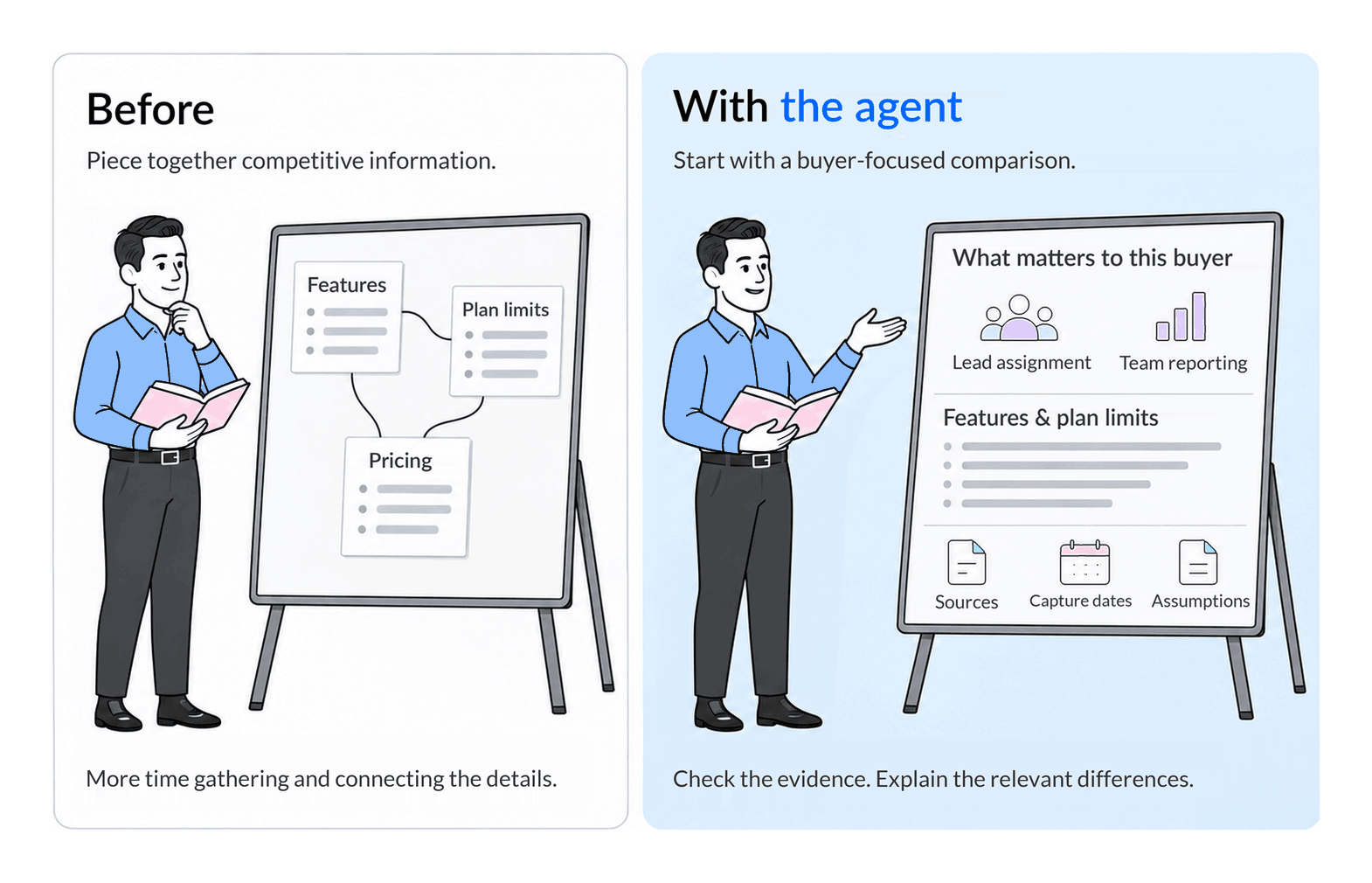
When a prospect asks how your product compares with a competitor's, your reps need to search the competitor's website, check pricing and features, and identify differences that matter to the prospect's needs. Gathering this information takes time, and an outdated comparison sheet can leave your reps relying on details that have changed.
The agent
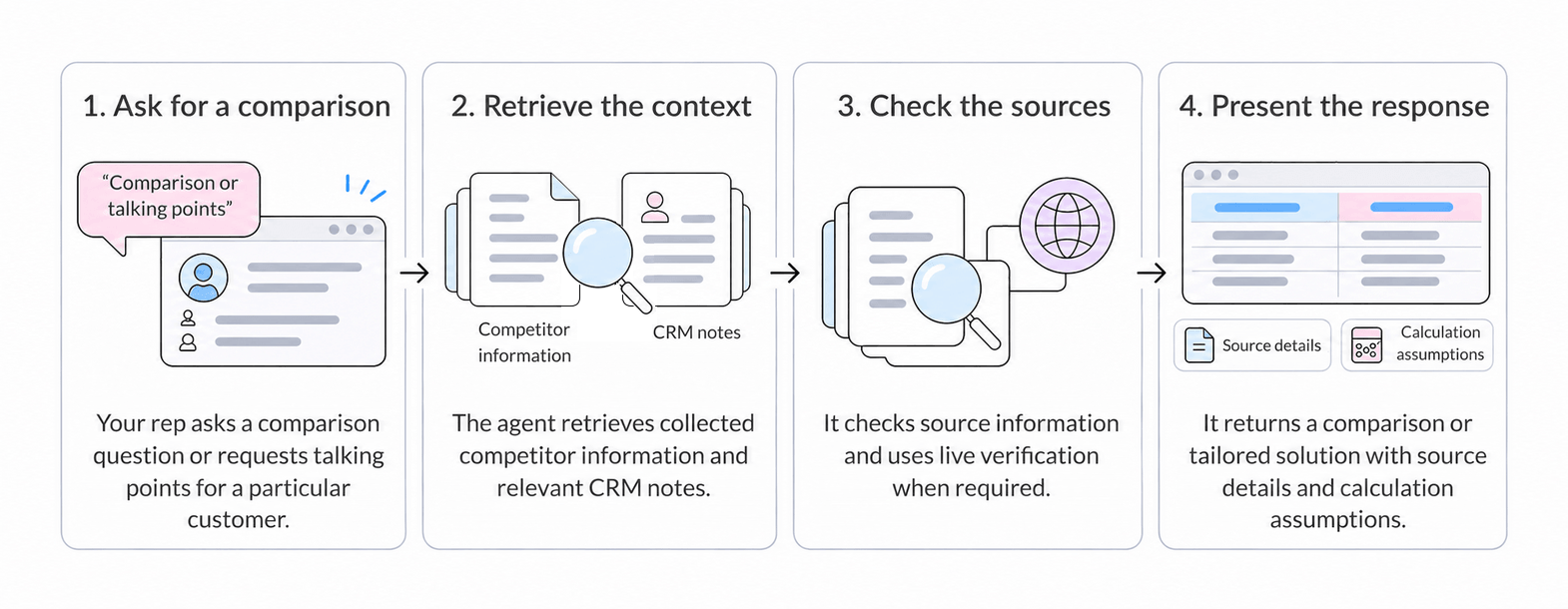
You can build an agent that uses your existing competitor research and the prospect's recorded needs to prepare a relevant product comparison. It checks available official sources when details need updating, explains pricing assumptions, and suggests talking points. It includes source links and when the information was checked, while flagging details it could not verify.
The process
The outcome
Your reps spend less time assembling competitive information and more time explaining the differences that matter to buyers. Source links and dates checked help them review the evidence and identify details that may need another check before use.
6. Sales hand-off agent
The challenge
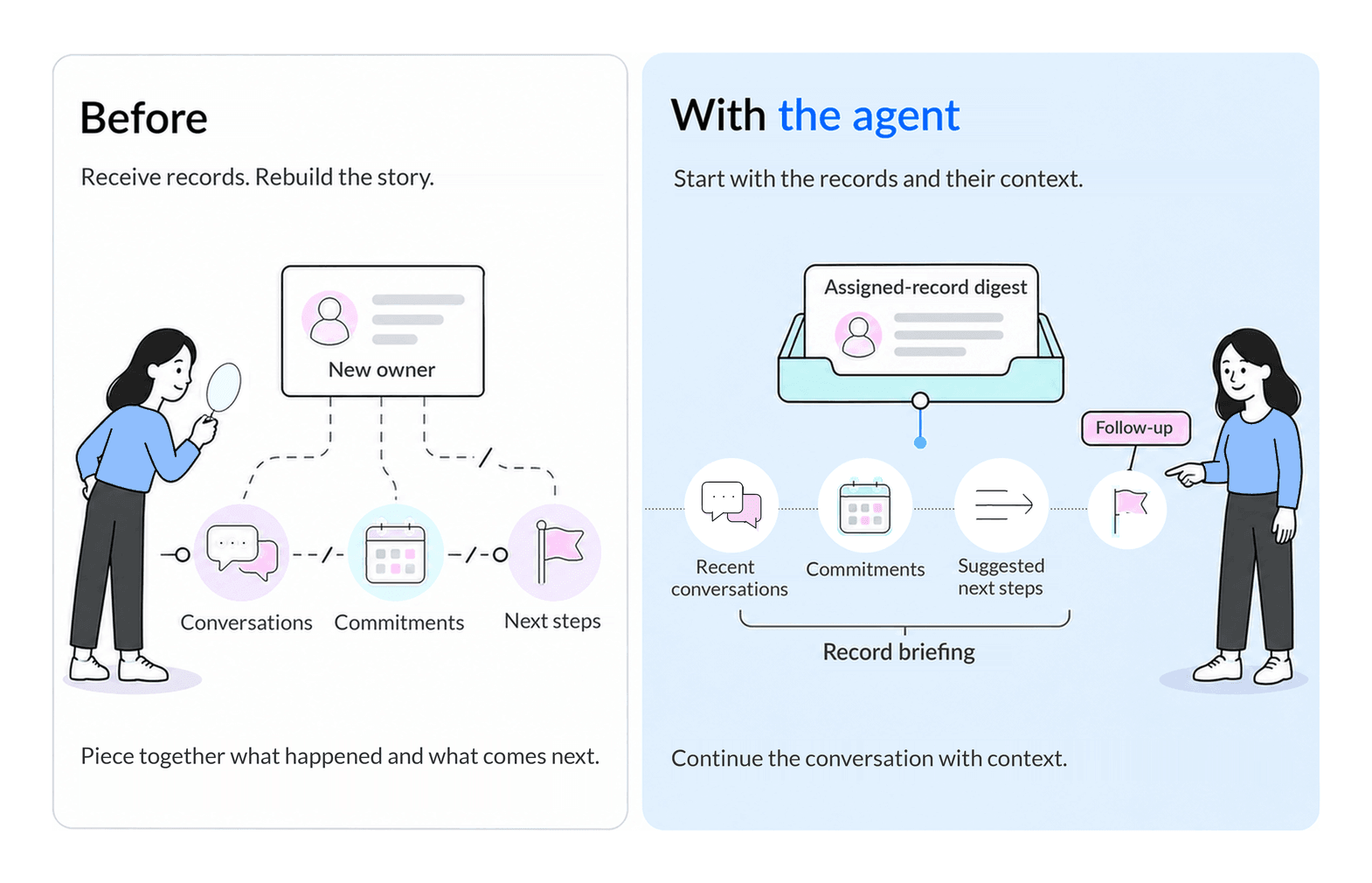
When a rep leaves or takes time off, changing record ownership is only part of the hand-off. The receiving rep also needs to understand customer concerns, outstanding commitments, and which deals need immediate attention.
The agent
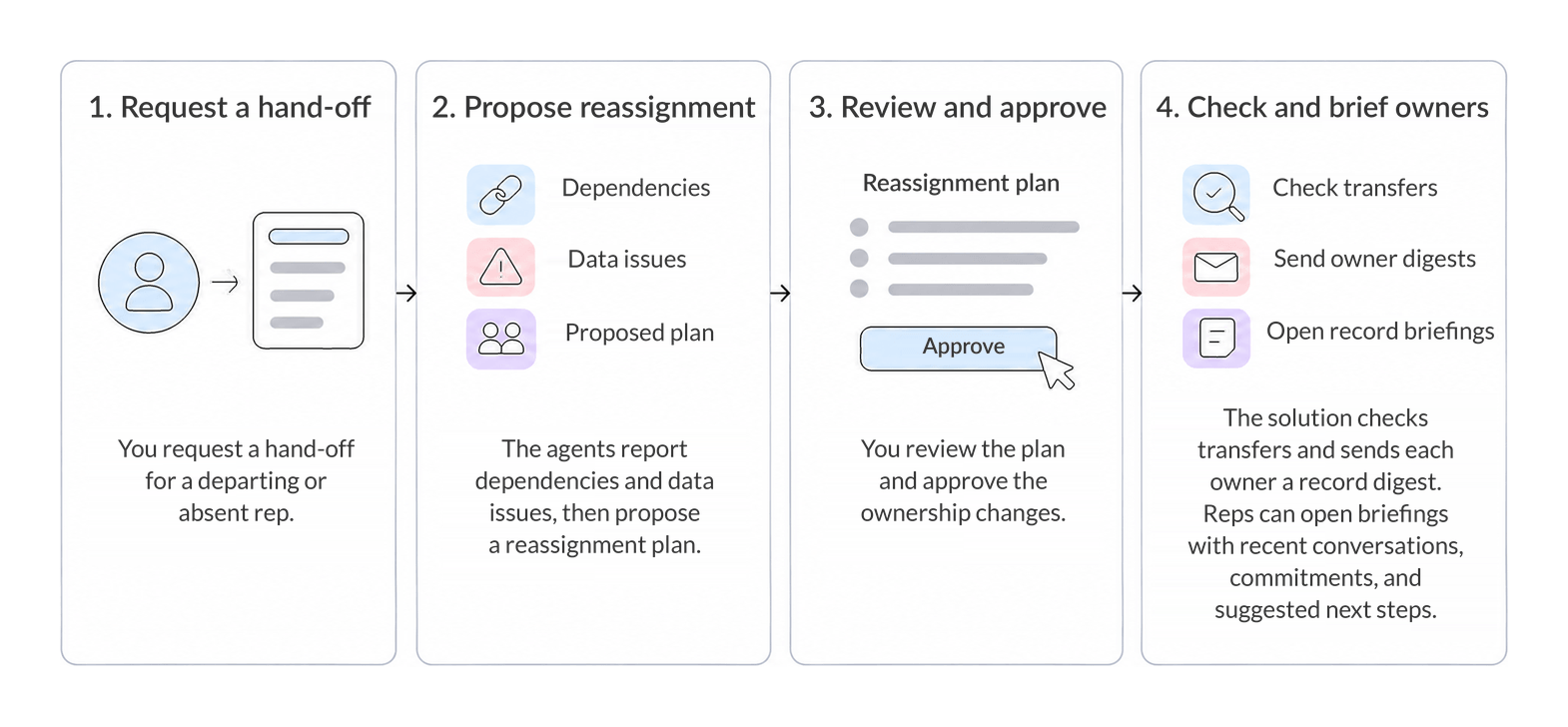
You can build a coordinated group of agents that check the hand-off, propose new owners, and brief the receiving reps. This solution reviews dependencies and data issues, considers deal urgency and team capacity, and waits for you to approve the transfer.
The process
The outcome
Your receiving reps get both the records and the context they need to continue the conversation. This can reduce time spent reconstructing a deal's history and help your team keep important follow-ups visible during a staffing change.
7. Sales delivery feasibility agent
Relevant for: Manufacturers and distributors assessing whether they can meet a customer's delivery deadline.
The challenge
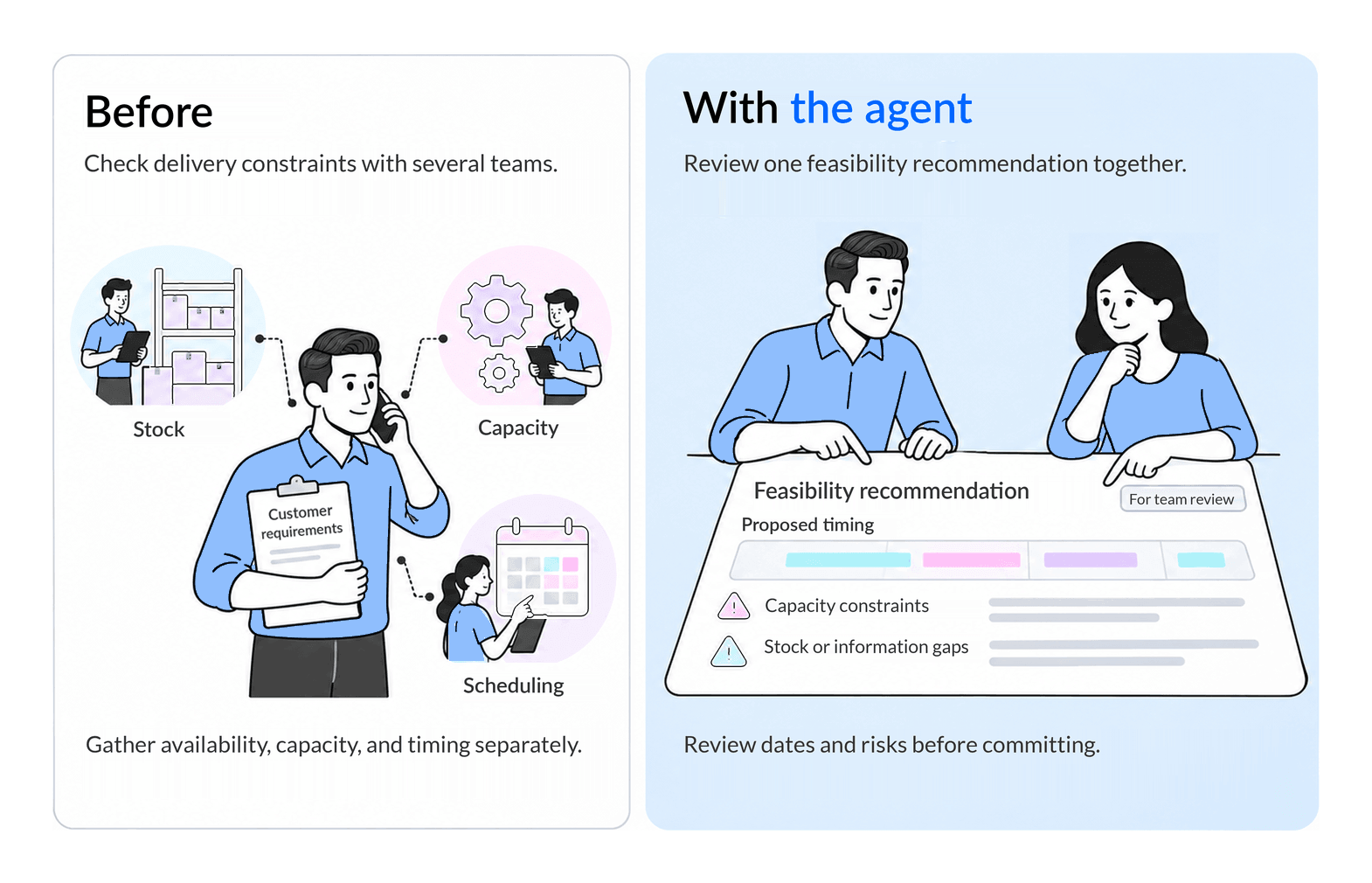
For manufacturers and distributors, winning an order can depend on meeting the customer's delivery deadline. Before promising a date, your reps need to check available stock, existing orders, and production schedules with your operations team.
The agent
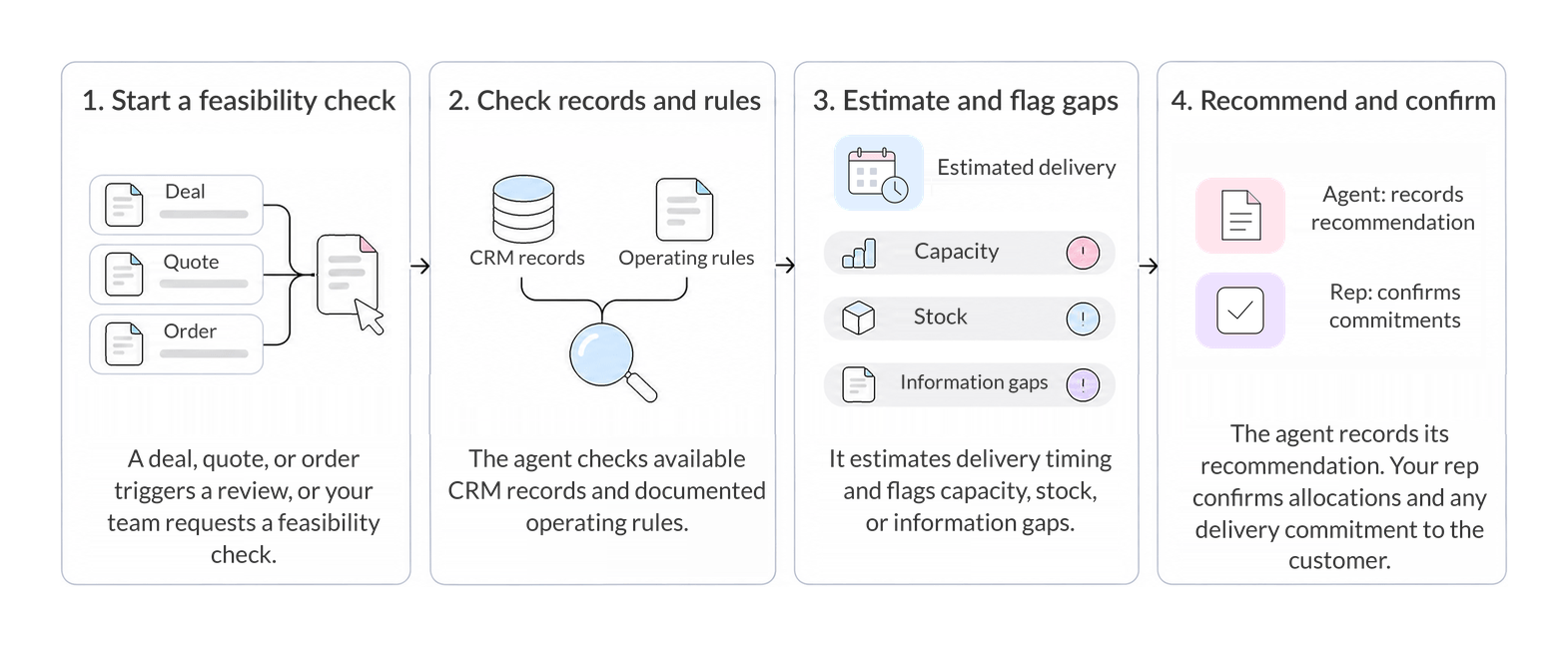
You can build an agent that checks the proposed order against your operational information and recommends what's feasible. For example, for a glass manufacturer, the agent reviews sales workload, production capacity, stock, and the order queue. It highlights delivery risks and quickly provides you with the feasibility details necessary to negotiate with the customer.
The process
The outcome
Your reps can discuss customer requirements with a clearer view of what the business can deliver. The recommendation gives sales and operations a shared basis for reviewing dates and constraints before committing to the order.
8. Cross-sell and upsell agent
The challenge
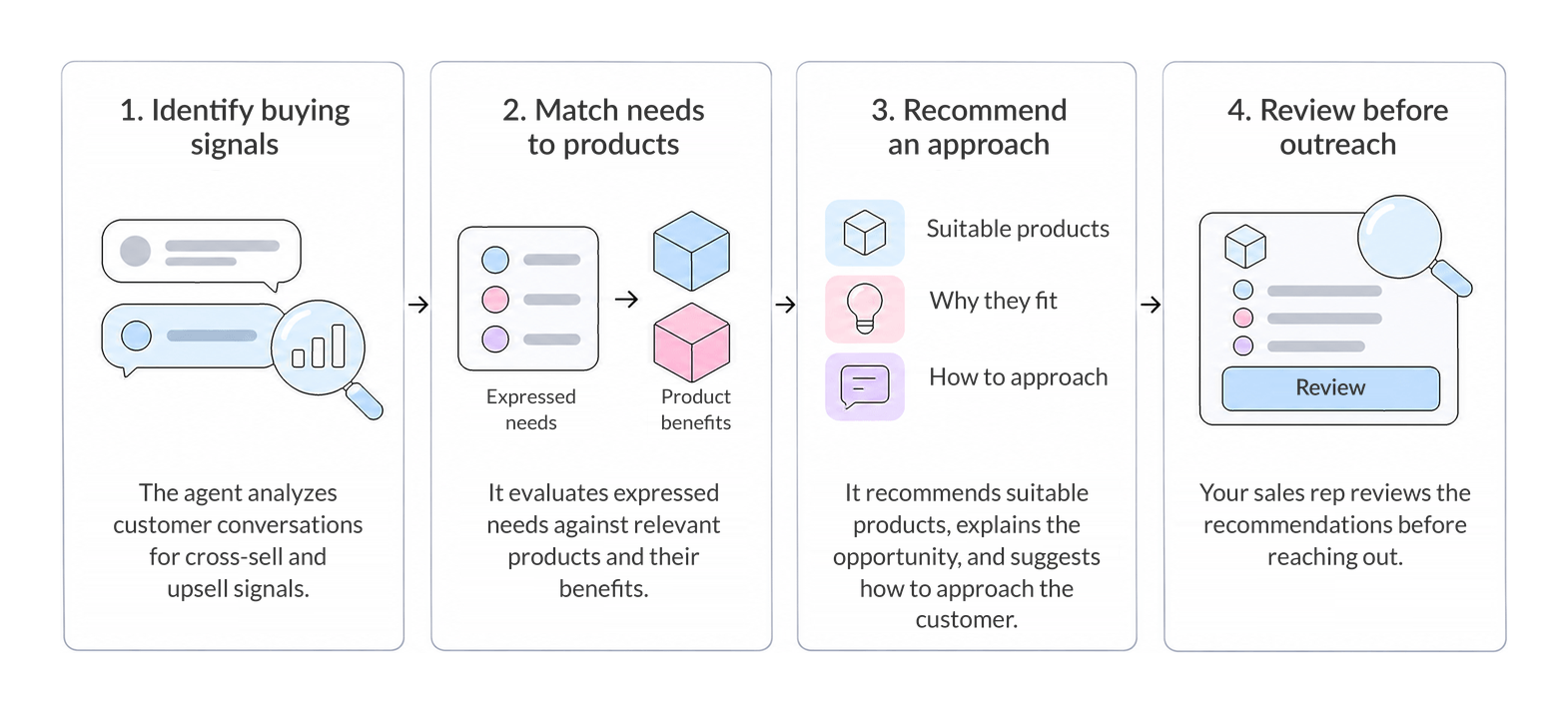
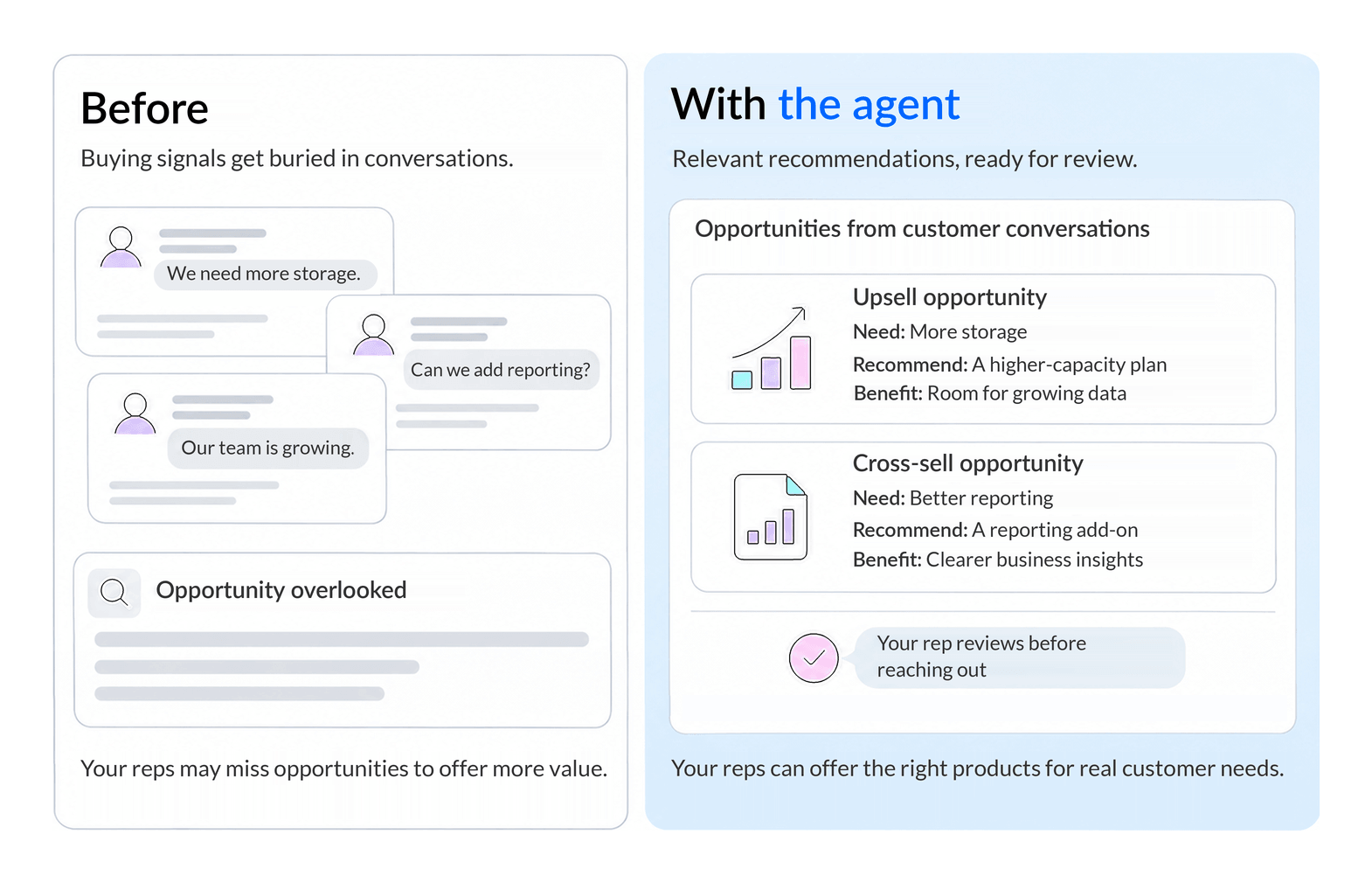
Customers often express interest in additional products during everyday conversations. These buying signals can go unnoticed, causing your sales reps to miss valuable cross-sell and upsell opportunities.
The agent
You can build an agent that identifies cross-sell and upsell opportunities from customer conversations, recommends relevant products, and explains why each recommendation could benefit the customer.
The process
The outcome
Your sales reps can identify opportunities hidden in everyday customer interactions and approach customers with relevant product recommendations. With clear reasoning and suggested next steps, they can pursue cross-sell and upsell opportunities while focusing on genuine customer needs.
9. Admissions inquiry and enrollment agent
Relevant for: Training institutes guiding prospective students from course inquiry to enrollment.
The challenge
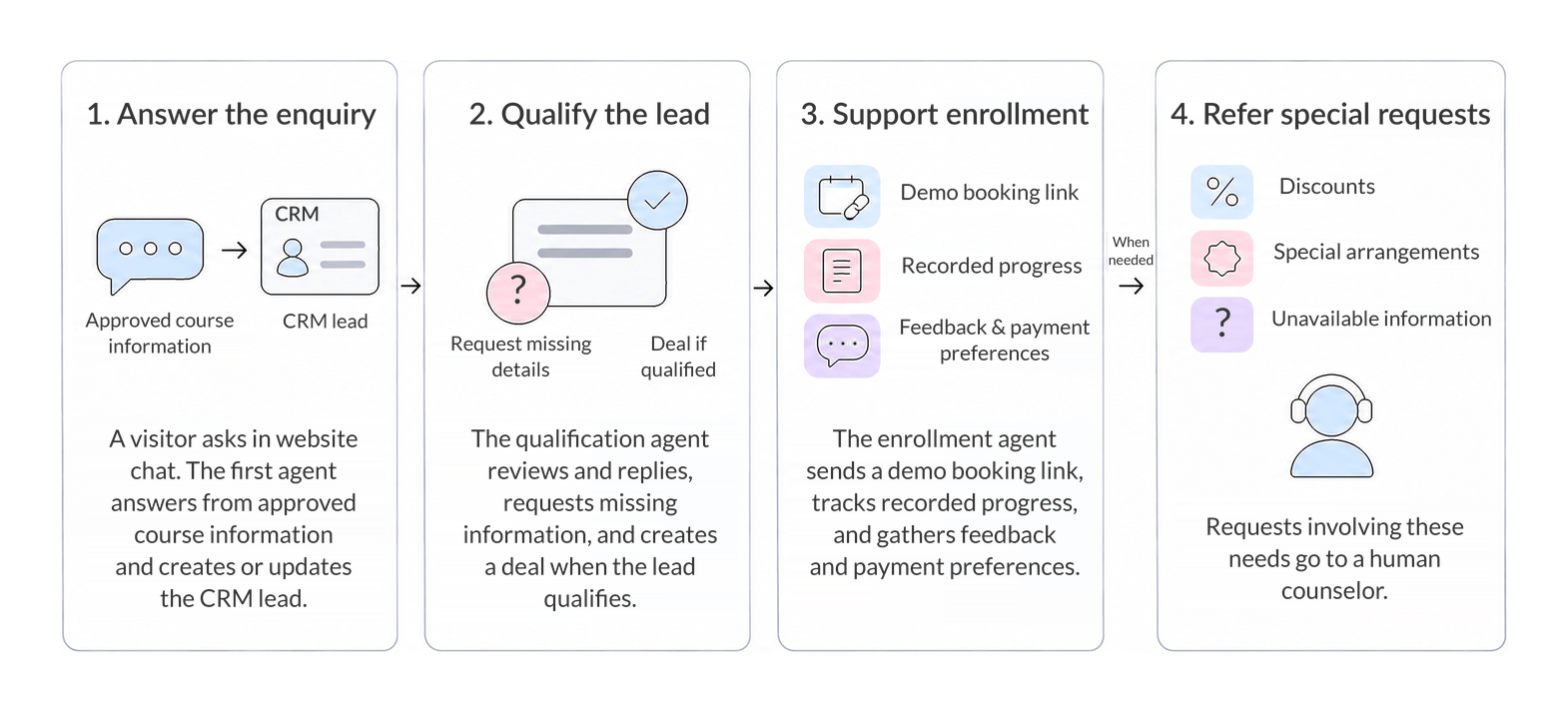
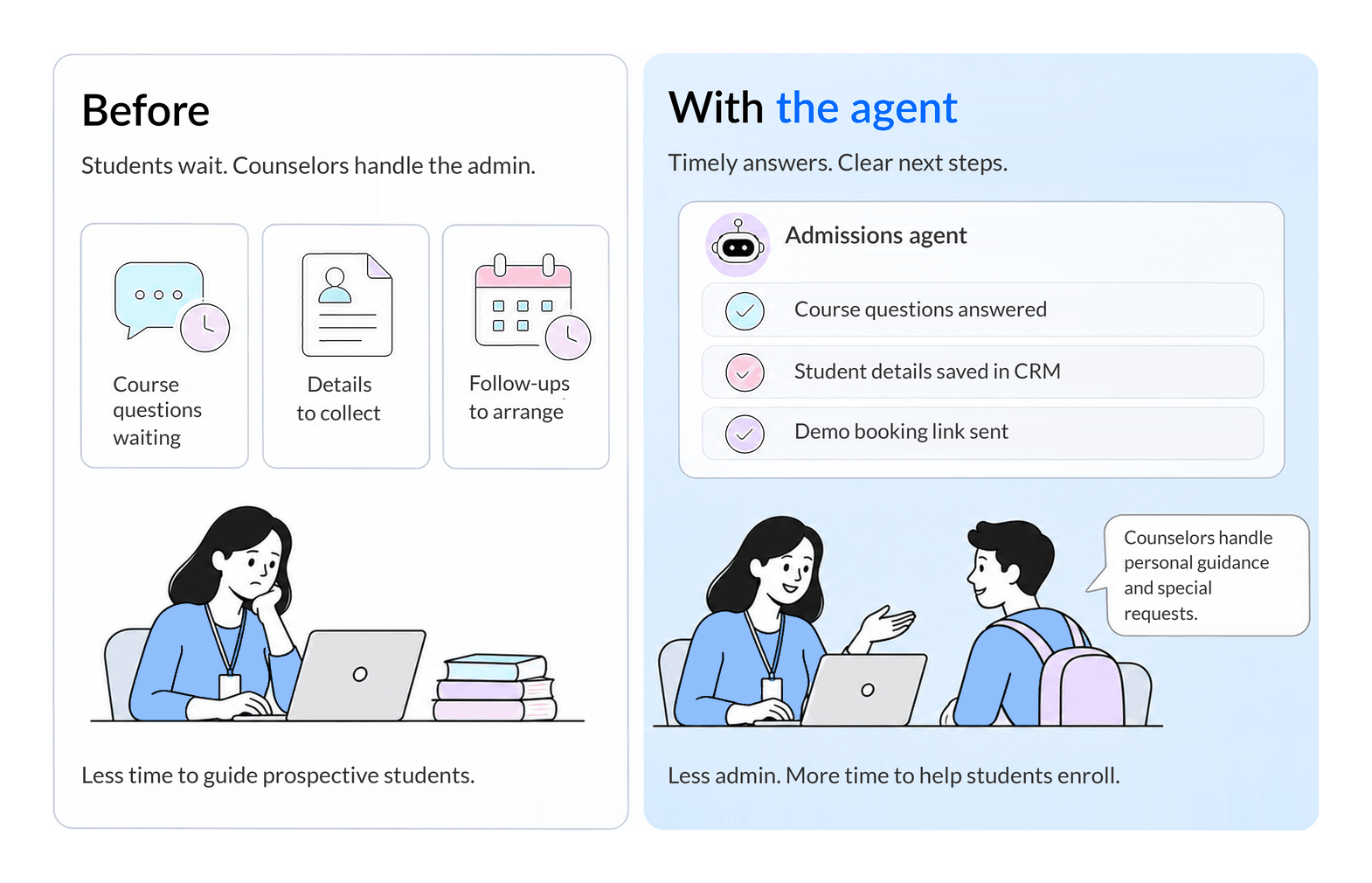
For a training institute, a prospective student may ask questions online, speak with a counselor, and attend a demo before enrolling. Your counselors need to connect those conversations to understand the student's goals, resolve unanswered questions, and guide the next step.
The agent
You can build a group of agents that supports the admissions sales journey. One answers course questions and captures inquiry details, another reviews students' interests, and a third helps coordinate demos and enrollment follow-ups. They share information through CRM records and hand special requests to a counselor.
The process
The outcome
Your prospective students get timely answers and clear next steps toward enrollment. Your counselors spend less time collecting details and coordinating follow-ups, so they can focus on guiding students and handling requests that need personal attention.
10. Tender review and proposal agent
The challenge
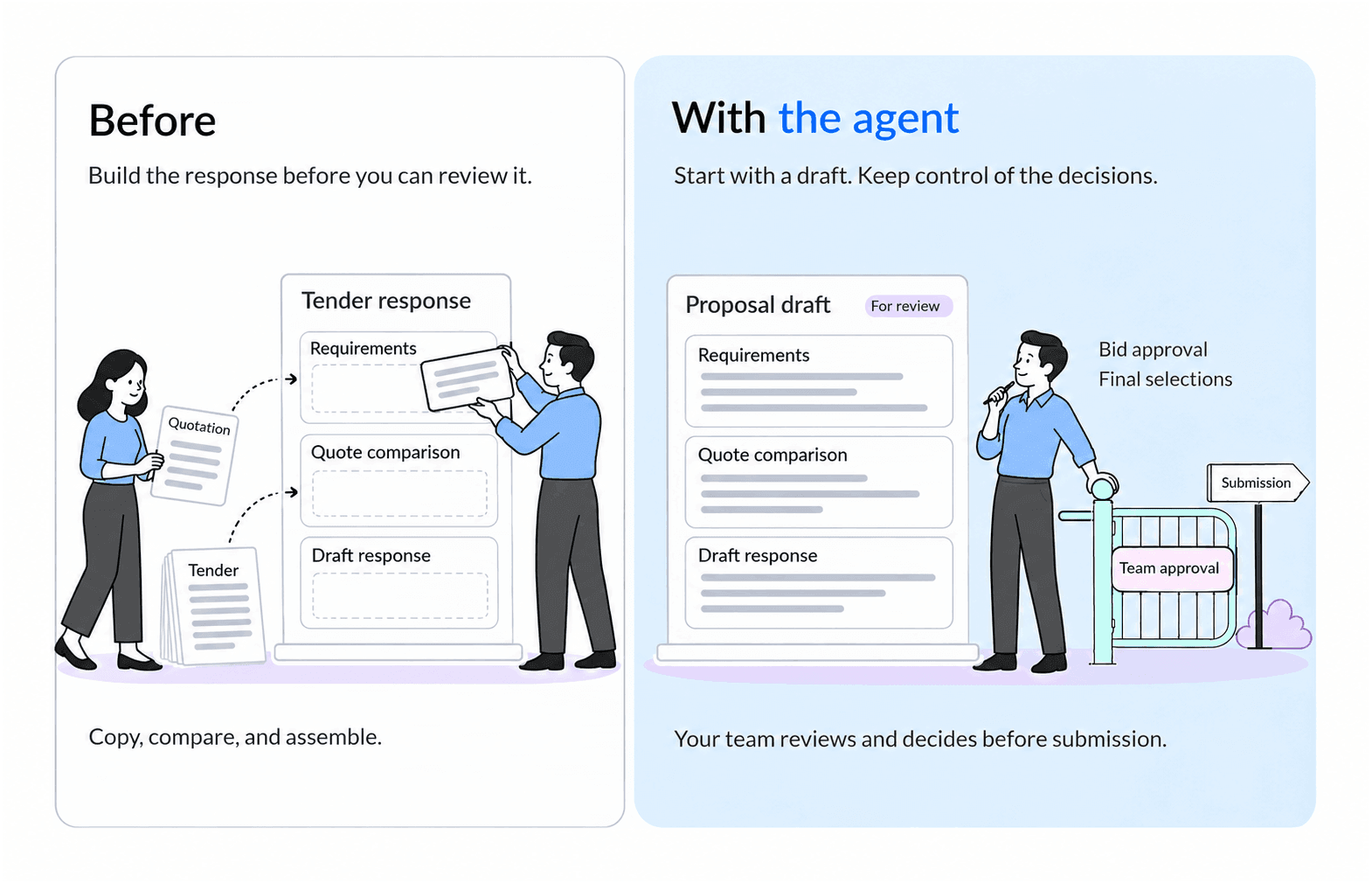
Preparing a tender response means reading a long requirements document, deciding whether to pursue it, and coordinating staff and delivery partners. Under a deadline, your team can lose time copying details and comparing quotations.
The agent
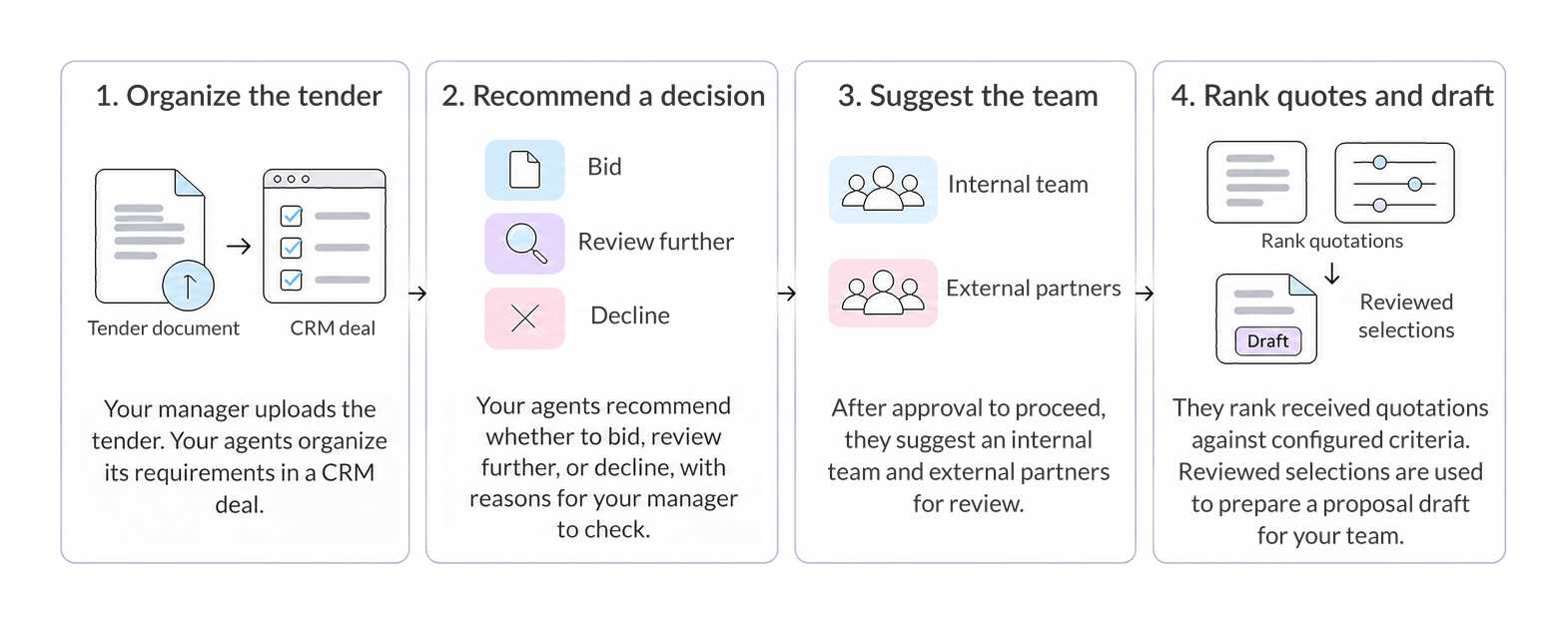
You can build specialist agents that organize tender information and help your bid manager prepare a response. The system extracts requirements, assesses fit against business criteria and past proposals, suggests staff and partners, and compares partner quotations. Its proposal stage is designed to assemble a first draft after the required selections.
The process
The outcome
Your bid manager can review organized requirements and comparisons rather than repeatedly assembling them from separate documents. Your team retains control over bid approval and final selections; the draft provides a starting point for checking the response before submission.
What do you need to build AI agents for sales?
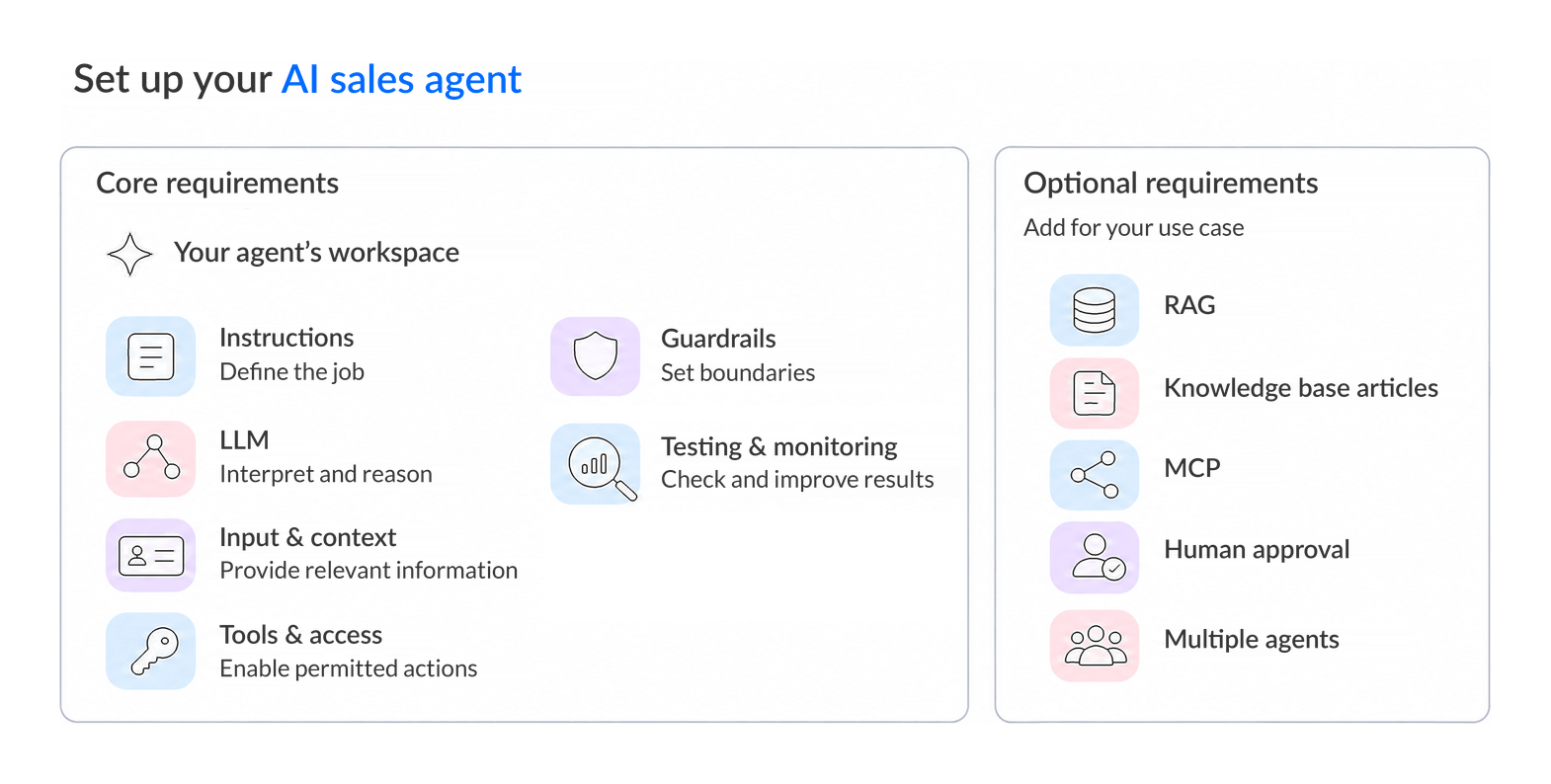
To build AI agents for CRM workflows, define the task, provide relevant customer information, and connect authorized tools for the actions you want them to perform. For the LLM-based agents in this article, you also need an execution platform, controls, and ongoing evaluation.
Core components and operational requirements
Instructions
Define what your agent should accomplish, the outcome you expect, and when it should stop or escalate to a person.
Large language model
Use a large language model (LLM) to enable your agent to interpret information, reason through its tasks, and determine its next actions.
Input and context
Give your agent the information it needs, such as customer requests, CRM records, and conversation history. Double-check that the information is relevant, accurate enough for the task, and available through authorized access.
Tools and access
Connect the tools your agent needs to retrieve information and perform actions. For example, a tool could read a CRM record or create an email draft. Grant permissions that match the agent's responsibilities.
Guardrails
Configure controls that help your agent follow business policies and handle requests outside its scope. For example, require it to use approved product information and avoid making unsupported promises. Combine these controls with access permissions and approval rules.
Testing and monitoring
Before deployment, test how your agent handles everyday tasks and responds when information is missing or an action cannot be completed. Review its activity afterward to identify errors and improve the configuration. Instructions and guardrails don't eliminate the need to check results.
Additional capabilities depending on your use case
Knowledge sources and retrieval
Give your agent access to approved information, such as product documentation, knowledge base articles, FAQs, and business policies. Retrieval-augmented generation (RAG) helps it find relevant details in these sources and use them when answering questions or completing tasks. You need this capability when your agent must consult information beyond what you provide directly.
Model context protocol
Use Model Context Protocol (MCP) to give your agent a common way to discover and use available tools and data exposed by compatible systems. For example, it can access CRM or calendar tools through that common interface. Direct integrations are another option; MCP doesn't eliminate the need for access permissions or application-specific setup.
Human approval
Have a human resource review actions that your business policies treat as sensitive or consequential, such as sending a proposal or changing record ownership. Whether approval is necessary depends on the action and the responsibilities you give the agent.
Multiple agents
Using multiple agents when dividing responsibilities can improve a complex workflow. Define each agent's task and handoff clearly. Start with one agent and add more when they serve a specific need.
Choose these additional capabilities according to the information and actions your task needs. More components don't automatically make your agent more useful.
How can you build AI sales agents with Zia Agents?
An agent-building platform brings all of these components together so you can configure the task and review how the agent performs it. Zia Agents is Zoho's agentic AI platform, where you can create an agent around your business requirements.
In Agent Studio, you can define a custom agent yourself or describe what you need to Zia, and review its suggested configuration. Either way, check the instructions, knowledge, tools, and guardrails before testing.
Your build process at a glance:
Define one task and the outcome you want to review.
Configure the instructions and connect the relevant knowledge and tools.
Set permissions, guardrails, and any required approval steps.
Test realistic scenarios, including missing information and failed actions.
Deploy through a supported connection or deployment method, then monitor and refine the results.
For Zoho CRM deployment, you can use an authorized connection or a digital employee where available. Check supported services and the permissions each method uses.
How do you choose your first AI sales agent?
Choose a frequent sales problem with a clearly defined task, accessible information, and an outcome you can measure. Your first agent should give you a manageable way to test its usefulness before you expand its responsibilities.
Which problem deserves attention first ?
Choose work that frequently delays your reps, consumes preparation time, or leaves important follow-ups unfinished. Define the problem narrowly enough to test.
Does the task need an agent ?
Use CRM automation for fixed conditions and predictable actions. Consider an agent when the task involves interpreting notes, answering varied questions, or choosing among permitted next steps.
Can you provide the necessary information ?
Check whether your CRM records, conversation history, and approved documents contain the information the task requires. Identify gaps before asking the agent to work around them.
Can you define clear boundaries ?
Specify what the agent can read or change and when a person must review its work. A read-only recommendation or reviewed draft can be a practical starting point.
How will you measure the outcome ?
Choose a measure that fits the task. Compare preparation time, correction rate, record completeness, or another relevant result against your current process. Use the same conditions where possible.
Frequently asked questions about AI agents for sales
Do I need coding skills to build an AI sales agent?
Not necessarily. In Zia Agent Studio, you can describe the task to Zia or configure the agent yourself. You still need to define its responsibilities, connect the necessary information and tools, and test its work. More specialized integrations may require technical support.
Can I start with an agent that only makes recommendations?
Yes. Your first agent can review information, suggest priorities, or prepare drafts without sending messages or changing records. You can review its work before deciding whether to give it permission to perform additional actions.
What should my agent do when customer information is incomplete?
Configure your agent to identify what is missing and ask for clarification or flag the record for review. For example, a qualification agent should mark a prospect as needing more information when the notes do not support a decision.
Can I adapt these agent examples to my sales process?
Yes. Use each example as a starting point, then adjust its instructions, information sources, tools, and approval steps to match your process. For example, your qualification agent should use your team's criteria and CRM statuses.
Build AI sales agents around the way your team works
The examples in this article give you a starting point. You can adapt them to the challenges your reps face, the customers you serve, and the sales processes you already follow.
Your first agent can help you test one practical improvement, such as preparing a useful follow-up with less manual work. Connecting it to your CRM gives it the customer context and tools that task requires.
Zia Agents in Zoho CRM shows how that connection can work within a sales process: An agent can use lead and deal information to support the next step. As you plan your first build, consider the task and the CRM capabilities it depends on together.
Start with one task your reps would gladly hand over—and build your first AI agent to help them move forward!