- HOME
- Threat types
- The irony of token theft: Unauthorized access using Auth tokens
The irony of token theft: Unauthorized access using Auth tokens
- Published : November 18, 2026
- Last Updated : November 18, 2026
- 16 Views
- 7 Min Read

The use of software applications has increased multifold in business environments. These applications are used to send and receive emails, store customer and client information, manage business operations, and handle confidential organizational data.
Access to these applications is secured through authentication mechanisms, including passwords, multi-factor authentication (MFA), single sign-on (SSO), OAuth, and passwordless authentication. However, authentication is only one layer of the security measures that protect organizational data.
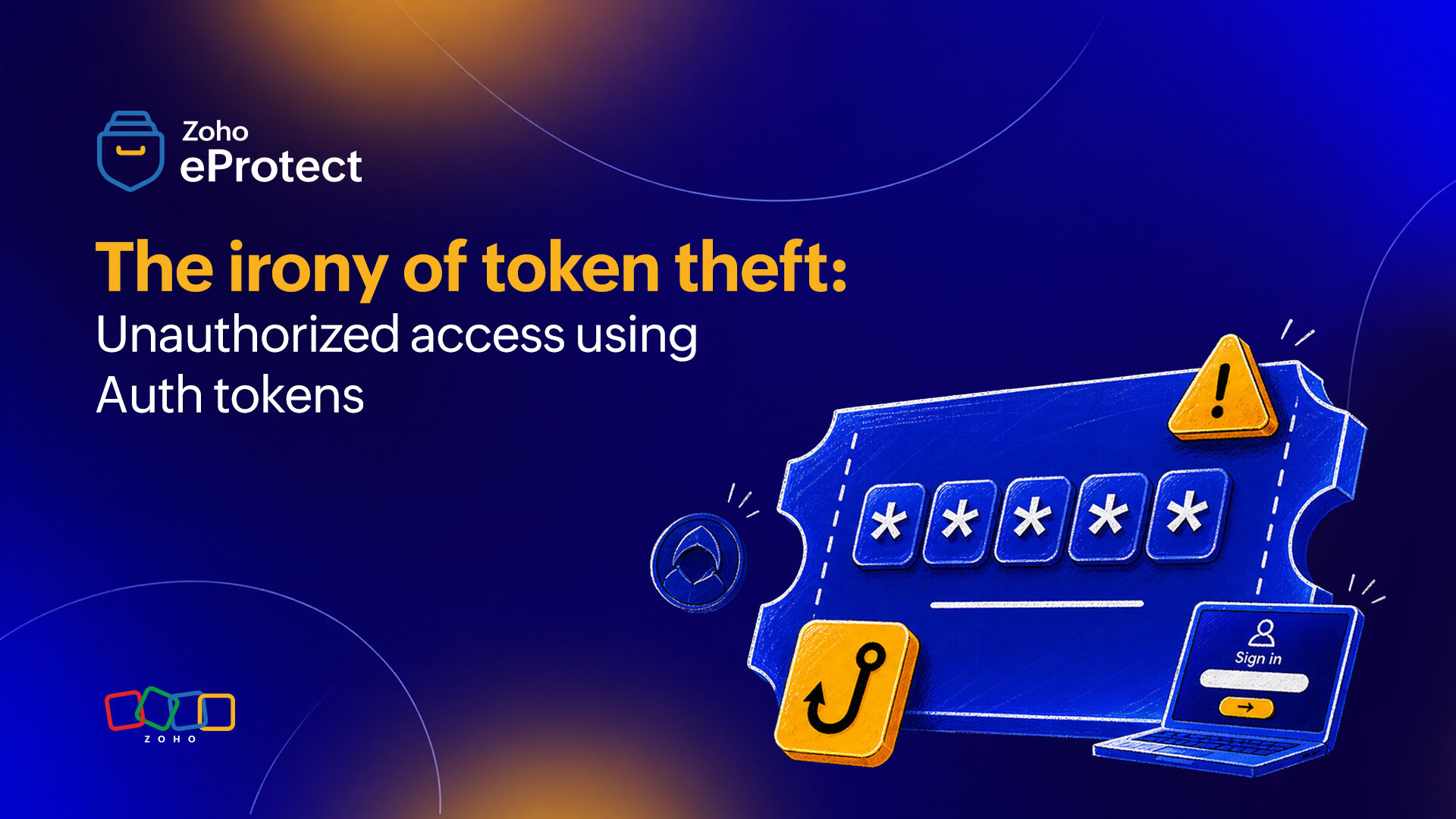
Once a user is successfully authenticated, authentication tokens are used to maintain an active session, allowing users to access applications without having to authenticate repeatedly. However, these tokens can also become targets for attackers. By stealing and reusing valid authentication tokens, attackers can impersonate legitimate users and gain unauthorized access to organizational resources.
This article provides an overview of token theft, the methods attackers use to steal authentication tokens, the risks associated with these attacks, and the measures organizations can take to protect their data.
What is token theft?
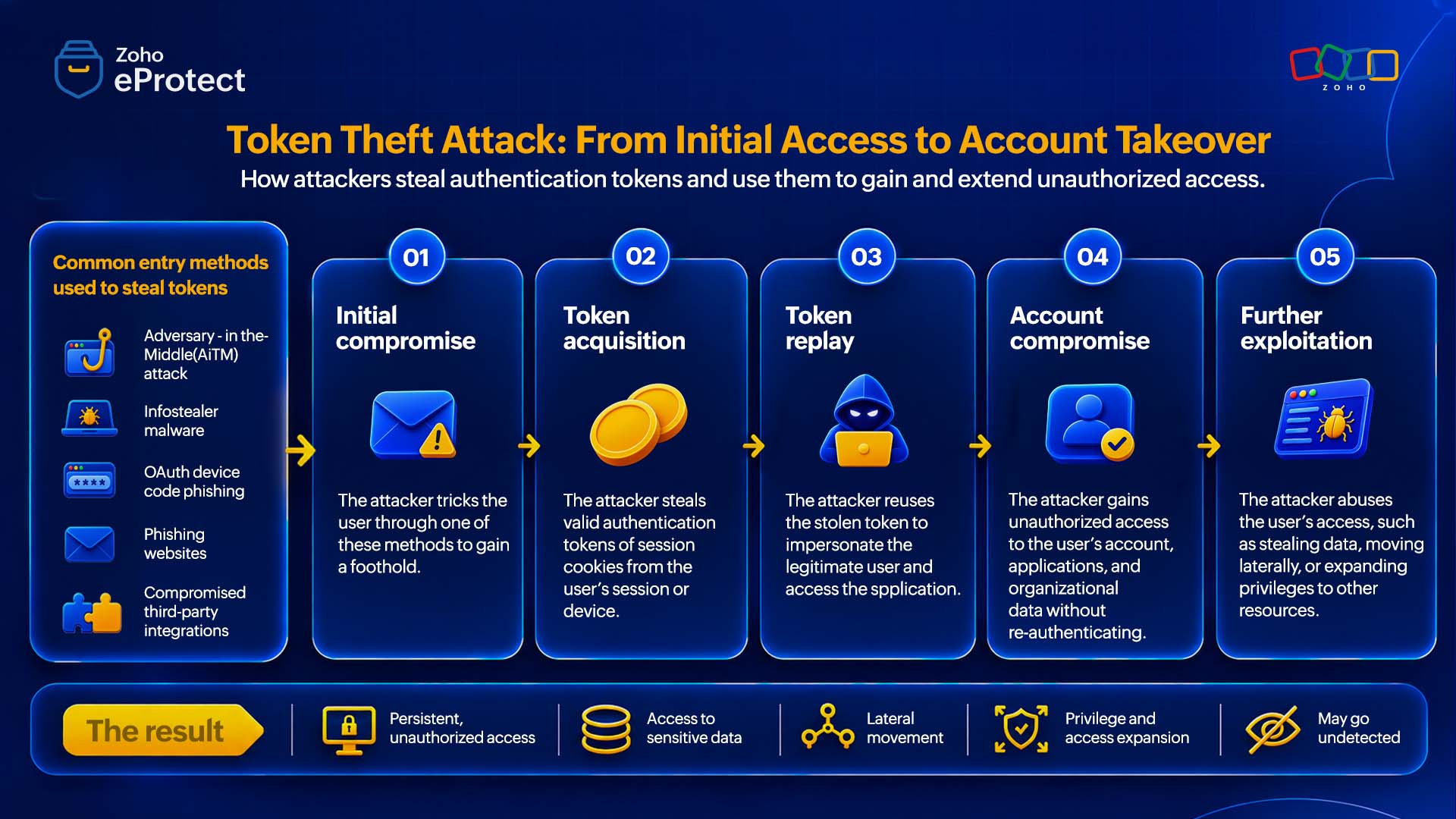
Token theft is a cybersecurity attack in which an attacker steals valid authentication tokens or session cookies to impersonate a legitimate user and gain unauthorized access to their accounts, applications, or other resources in an organization.
When they steal these tokens, they'll be able to reuse the authenticated session even without the user's password and the need to bypass MFA. This makes an organization's data vulnerable because it enables attackers to bypass the authentication controls and have access until the compromised token or session is invalidated.
What is an authentication token?
An authentication token is a digital credential issued by an authentication service or identity provider after a user successfully verifies their identity through their account credentials. Instead of repeatedly authenticating with a username, password, and MFA, applications use these tokens to recognize an authenticated user and grant access to authorized resources.
Tokens are issued during the authentication process and have specific purposes, permissions, and validity.
Types of authentication tokens and what they are used for
- Access tokens: To access specific applications, services, or APIs, they denote the permissions granted to a user or application and are generally short-lived.
- Refresh tokens: These are used to obtain new access tokens without requiring the user to authenticate again. Depending on the implementation, they may remain valid for longer periods.
- ID tokens: Used in OpenID Connect (OIDC) to communicate information about an authenticated user to a client application, they are not intended to serve as general-purpose API access credentials.
- Session cookies: These are small pieces of data stored by a browser to maintain an authenticated session with a website. They contain a session identifier or other session-related information that allows the server to recognize an authenticated user.
How does an Auth token work?
Understanding how an authentication token works will help you get an idea of how a stolen token will be used and put your and the organization data at risk.
- When a user wants to access an application, they provide their credentials and complete the required authentication process, including any MFA configured to access the application.
- The identity provider validates the user's identity and issues the relevant authentication tokens.
- The application or browser stores the required tokens or session information.
- Subsequent requests use these credentials to establish that the user has already authenticated.
- When an access token expires, a valid refresh token is used to obtain a new access token without requiring the user to log in again.
This enables seamless access across applications and services. However, when these tokens or session credentials are compromised, an attacker will reuse the authenticated session and keep their access active as long as the session isn't invalidated or terminated.
How does a token theft attack take place?
An attacker uses different methods to steal an authentication token or session cookies. Here are some of the commonly used methods.
AiTM (Adversary in The Middle) attacks
In AiTM attacks, a phishing website similar to an authentic one is created by the attacker. This website will work as an intermediary between the user and the legitimate authentication service.
The user, unaware that the website they're accessing is not legitimate, attempts to log in with their account credentials. The attacker intercepts the authentication process and captures the generated auth tokens or session cookies. This enables the attacker to reuse the authenticated session, even when MFA is in place, as the user has already completed the authentication.
Infostealer malware
Infostealer malware infects a user's device and extracts sensitive information stored in browsers, applications, and the system memory.
This include session cookies, authentication tokens, saved credentials, and other sensitive information. Attackers then use the stolen information to impersonate the legitimate user and gain access to data, system, and applications.
OAuth device code phishing
The attacker exploits the OAuth device authorization flow to trick the user into entering a device code generated by them.
The user will be of the assumption that they are authenticating a legitimate application or device to access their account. However, they are actually authorizing an attacker-controlled session or application, allowing the attacker to obtain tokens associated with the user's account.
Phishing websites
Fraudulent websites that imitate legitimate login pages are created and users are tricked into entering their credentials and, in some cases, MFA verification codes.
Depending on the attack technique, attackers may capture authentication information or use the credentials to obtain valid session tokens.
Compromised third-party integrations
Based on organizational requirements, any third-party applications and integrations may have access to organizational resources through OAuth permissions or other authentication mechanisms.
If an integration or its credentials are compromised, attackers abuse its authorized access to steal sensitive information or perform actions on behalf of the connected account.
Risks associated with a token theft attack
When an attacker successfully completes a token theft attack, the risks associated with that is multi-faceted.
Unauthorized access without repeated authentication
Attackers can reuse valid tokens or session cookies to access applications without entering the user's password or re-authenticate the session using MFA.
Persistent access
Long-lived refresh tokens or session cookies can allow attackers to maintain access for extended periods, even when the legitimate user is not actively using the application.
Undetected account compromise
Token misuse doesn't usually trigger conventional password-based security alerts because the attacker is reusing an already-authenticated session. Without appropriate behavioral monitoring, such activity might go unnoticed.
Sensitive data exposure
Attackers can access emails, documents, files, customer information, and other resources available at the disposal of a compromised account.
Lateral movement
A compromised account can become an entry point for further attacks. Attackers may use the account's existing permissions and trusted connections to access additional applications, services, and other resources.
Extend scope and privilege
Attackers can exploit existing permissions, abuse OAuth tokens, or compromise additional accounts to gain access to more sensitive actions and administrative capabilities.
How to prevent a token theft attack
Adoption of a multi-layered security approach is imperative to reduce the likelihood of token theft, detect suspicious token usage, and limit the impact of compromised sessions.
Bind tokens to devices and browsers
Use device-bound or sender-constrained token mechanisms wherever supported. These mechanisms bind tokens to a specific device or cryptographic key, making it more difficult for attackers to reuse stolen tokens from another environment.
Also, enforce access from trusted, managed, and compliant devices through conditional access policies.
Phishing-resistant authentication
Implement phishing-resistant authentication methods such as FIDO2 security keys and passkeys. The credentials of these keys are bound to the application through cryptography.
This prevents the attackers from capturing and reusing credentials through fraudulent login pages. However, additional endpoint and session protection is still necessary to defend against token theft.
Set shorter token lifetimes and rotate them
Configure appropriate token lifetimes based on the sensitivity of the resources being accessed.
Use refresh token rotation, token revocation, and session expiration policies to limit the period during which compromised credentials can be reused.
Behavior-based monitoring and alerts
Monitor authentication activity and identify suspicious patterns, such as:
- Sign-ins from unusual locations or devices
- Unexpected changes in user-agent or device characteristics
- Unusual non-interactive sign-in activity
- Unusual access to sensitive resources
- Unexpected mass downloads or data transfers
- Suspicious changes to MFA methods, OAuth permissions, or mailbox rules
Just-in-Time (JIT) access and least privilege
Grant elevated permissions only when required and for a limited duration.
Apply the principle of least privilege so a compromised user account cannot automatically access sensitive organizational resources or administrative functions.
Conditional access policies
Enforce access policies based on user identity, device compliance, location, application sensitivity, and sign-in risk.
Require additional authentication or block access when the session does not satisfy the organization's security requirements.
Secure third-party application integrations
Review OAuth application permissions and third-party integrations regularly.
Remove unnecessary permissions, restrict application consent, and monitor applications with access to sensitive organizational data.
Endpoint and browser protection
Keep operating systems, browsers, and endpoint security solutions updated.
Use endpoint detection and response (EDR) capabilities to identify infostealer malware and suspicious access to browser-stored authentication information.
What should you do if a token is compromised?
A token theft should be treated as an identity compromise rather than a simple password compromise.
Recommended response measures include:
- Revoke active sessions and refresh tokens associated with the compromised account.
- Disable or restrict the compromised account temporarily if immediate containment is required.
- Investigate the affected device for infostealer malware or other signs of compromise.
- Review sign-in logs, application access, OAuth grants, and suspicious account activity.
- Reset credentials and re-establish trusted authentication methods where necessary.
- Review mailbox forwarding rules, newly registered authentication methods, and changes to account permissions.
- Assess whether other accounts, applications, or organizational resources have been accessed.
Revoking tokens alone may not immediately invalidate all the tokens issued already. Organizations should follow their identity provider's incident response guidance and ensure that compromised devices and sessions are contained.
Zoho eProtect is a cloud-based email security and archiving solution that helps organizations protect their email environments against evolving email threats. Through advanced threat detection, eProtect helps identify suspicious emails and malicious content that evade conventional content filters. By strengthening email security and helping organizations detect potential phishing attempts and other email-borne threats, eProtect adds an additional layer of protection against attacks that could lead to credential compromise and token theft.